
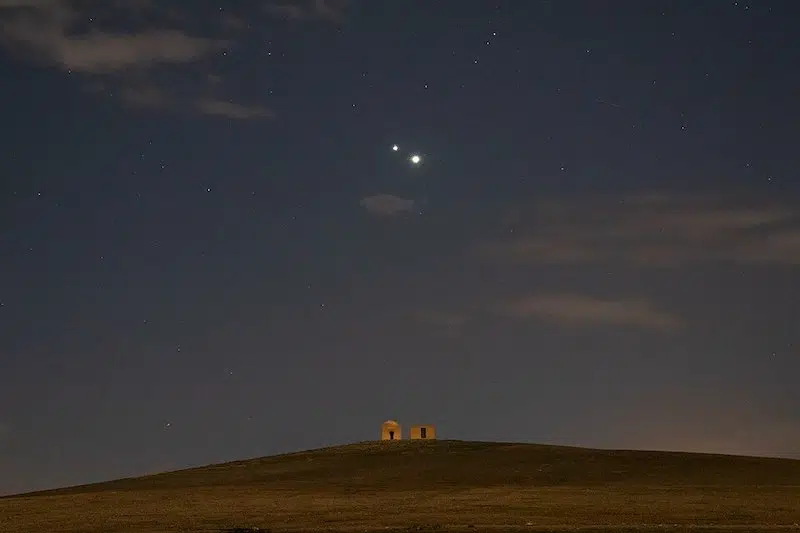
Conjunction of Jupiter and Venus seen on March 1, 2023 from Oujda, Morocco. (Photo: Brahim FARAJI via Wikimedia Commons, CC BY-SA 4.0)
The two brightest planets visible from Earth are putting on a spectacular sky show this June. Over the next two weeks, Venus and Jupiter will appear unusually close together in the western sky after sunset, culminating in a striking alignment with the crescent moon on June 16 and 17.
The celestial event centers on a planetary conjunction, which occurs when objects appear close together in the sky from Earth’s perspective. Throughout early June, Venus and Jupiter will draw nearer to one another each evening, creating one of the year’s most eye-catching astronomical sights.
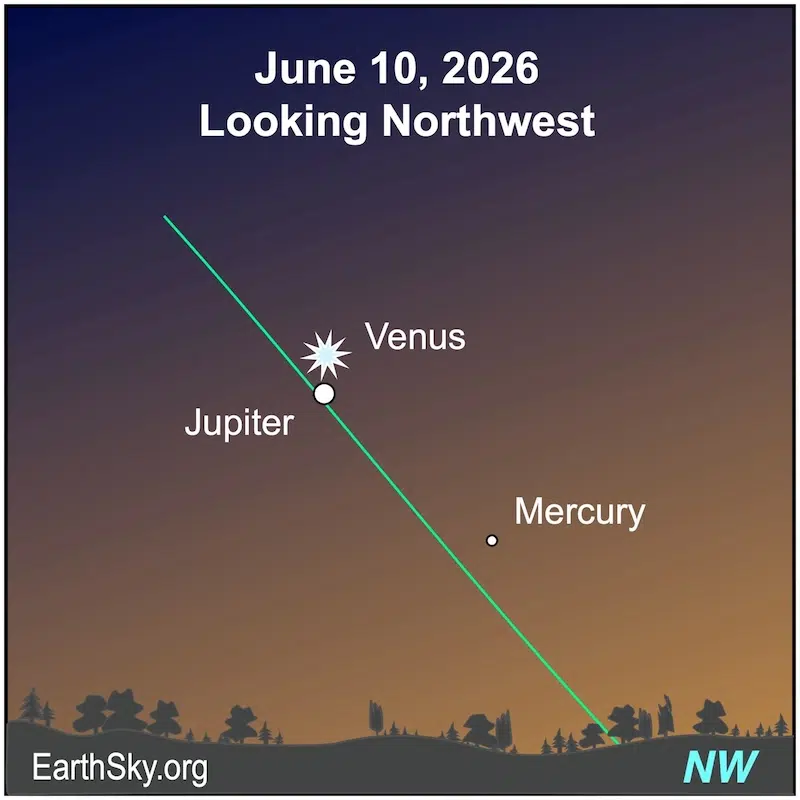
Mercury joins the display lower on the western horizon, forming a diagonal line of planets that stretches across the twilight sky. The arrangement has earned the nickname “planetary skewer” among some skywatchers.
At their peak, Venus and Jupiter will sit only a few degrees apart, close enough to cover the gap between them with a pinky finger held at arm’s length. Both planets will shine brightly enough to see without binoculars or a telescope.
Although the two planets begin separating after June 10, the planetary lineup continues to impress. The highlight arrives a week later when the moon joins the scene. Anyone with a clear western horizon can watch the planets without special equipment. Observers should head outside 30 to 60 minutes after sunset and look toward the western sky.
The alignment will look similar from the Southern Hemisphere, though the lineup will appear mirrored. The planets and moon will still form a prominent chain across the evening sky. From night to night, observers can watch Venus, Jupiter, Mercury, and our moon shift positions against the background stars, creating a celestial display that changes with each sunset.
The best viewing opportunities will continue through mid-June before the planets gradually sink lower into the evening twilight. For skywatchers willing to spend a few minutes outdoors after sunset, this rare planetary gathering promises one of the most beautiful sights of the month.
Venus and Jupiter appeared unusually close together after sunset on June 8 and will continue to be visible on June 9.
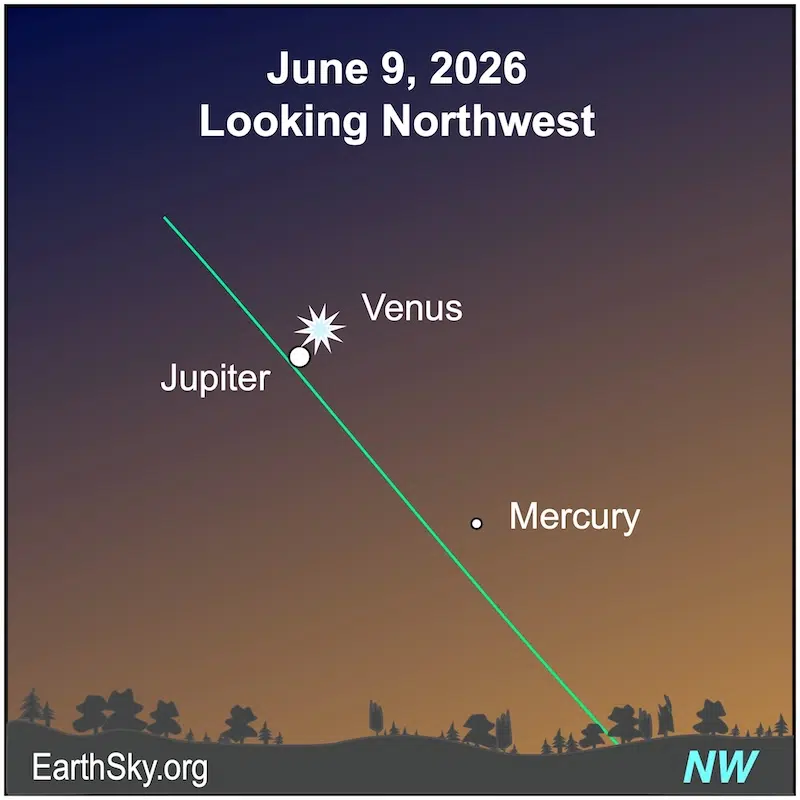
This alignment creates one of the year’s most beautiful planetary conjunctions.
View this post on Instagram
After the conjunction, Jupiter and Venus are still close, but they’ll be moving away from each other.

Sources: See Our Two Brightest Planets Form a Triple Alignment with the Moon After Sunset; Visible planets and night sky guide for June
Related Articles:
NASA’s Artemis II Crew Name Newly Discovered Moon Crater After Astronaut’s Late Wife, Carroll
Meet the Four Astronauts Who Are Currently on Their Way to the Moon
Total Lunar Eclipse Will Turn the Full Moon a Rich Copper‑Red in March
You Can See Four Planets Shining Brightly in the Night Sky Every Night in January