

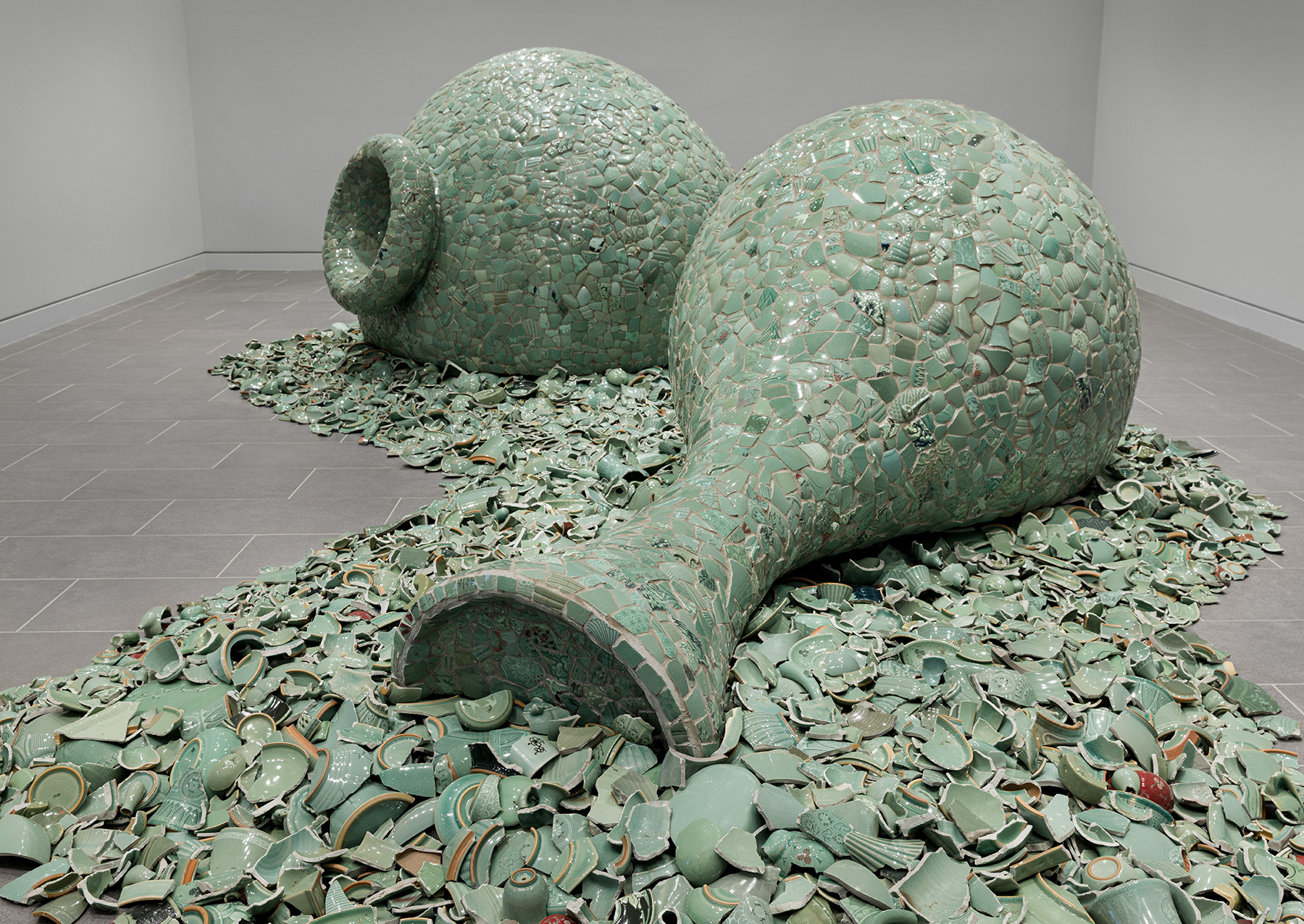
Installation view of “Celadon Landscape,” now on view at the Green-House at Green-Wood Cemetery in Brooklyn, NY. (Photo: Etienne Frossard)
During one of her trips to Korea, Jean Shin met with several ceramic artists in their studios. But, during these visits, she made an unexpected discovery: many studios harbored mounds of discarded shards in their back rooms. As she scanned these piles, the artist quickly realized that the remnants had come from finished ceramic vases that potters destroyed due to minor imperfections. She also realized that the shards could be reborn.
Shin’s resulting sculpture, Celadon Landscape, takes the form of two mosaic vessels, both clad in the repurposed ceramic shards. These shards, however, aren’t simply plastered onto these vases, and are instead strewn across the floor. Taken together, the effect is one of resurfacing, of inhaling once again, as if the two vases have just burst out from a turquoise sea. These oceanic motifs can of course be attributed to the work’s color palette, which echoes and reinvents traditional Korean celadon vases. But they also hint at a very specific journey, one that was taken by each and every shard composing Celadon Landscape.
Nearly two tons of these fragments were shipped from Korea to Shin, donated by kilns in and around the city of Icheon. In that way, Celadon Landscape mines the diasporic experience, unveiling the drama not just of separation, but of recreation.
“The diaspora community, like myself, have somehow been broken away from our birthplace,” Shin recently told Hyperallergic. “And yet in all the displacement and the distance, we’re still Korean, even though our context, language, and customs have shifted.” The shards, then, aren’t simply reminders of a life foregone. Instead, they are vital materials through which to fashion a new world, effectively combining the past, present, and future.
“The fragments [are] a metaphor of the Korean diaspora, vibrant artifacts of the Korean people, their history and culture, that are scattered all over the world to form new identities elsewhere,” Shin writes of the work.
Now, after being showcased at the Crow Museum of Asian Art in Dallas and the Sarasota Art Museum, Celadon Landscape has landed at Brooklyn’s Green-Wood Cemetery. The work occupies the cemetery’s Green-House, which recently opened and serves as the site’s “new front door.” As the inaugural exhibition at the center, Celadon Landscape encourages visitors to participate in its meaning through active engagement. Torn pieces of mulberry paper, all mimicking the work’s celadon color, prompt reflection on a seemingly simple question: Who do we carry with us? Once guests write down their thoughts, they are subsequently collaged by Shin onto a large scroll for the surrounding gallery walls, extending the work beyond its ceramic surface.
“Celadon vases occupy a prized place in Korean cultural history—objects of reverence, painstakingly made and carefully preserved,” Shin explains. “In Celadon Landscape, I shift the gaze to what is usually discarded. I see in their imperfection not loss, but beauty—fragments that still pulse with the memory of Korea’s enduring legacy.”
It’s a fitting message, especially considering the sculpture’s location. Similar to Celadon Landscape, cemeteries demand meditation upon what is lost and what is gained. Under these circumstances, fragments are more than mere remains—they are vessels, much like those that comprise Shin’s installation.
Jean Shin: Celadon Landscape is on view at the Green-House at Green-Wood Cemetery through January 17, 2027.
In Celadon Landscape, artist Jean Shin repurposes discarded ceramic shards from Korean artisans into monumental mosaic vases.
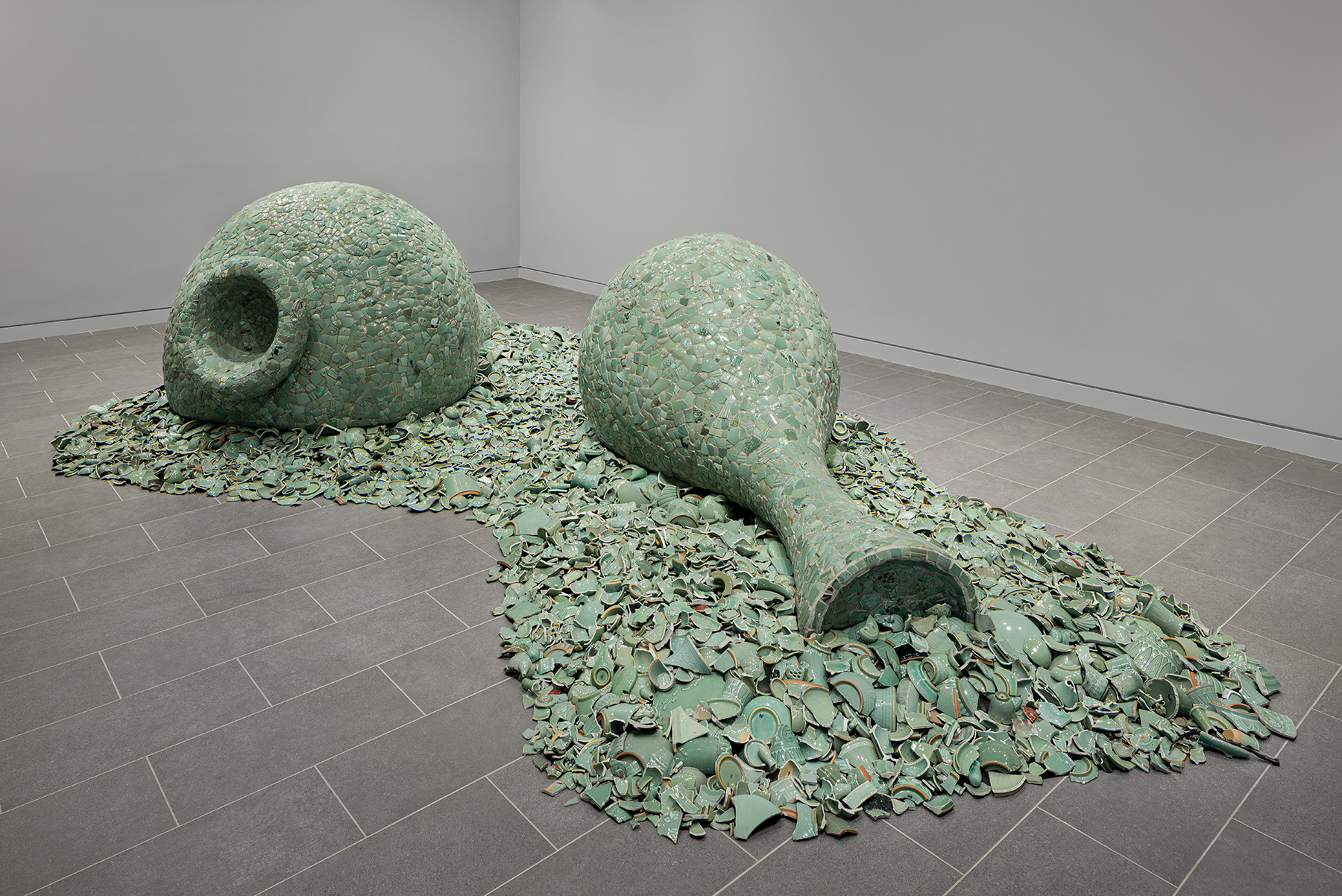
Installation view of “Celadon Landscape,” now on view at the Green-House at Green-Wood Cemetery in Brooklyn, NY. (Photo: Etienne Frossard)
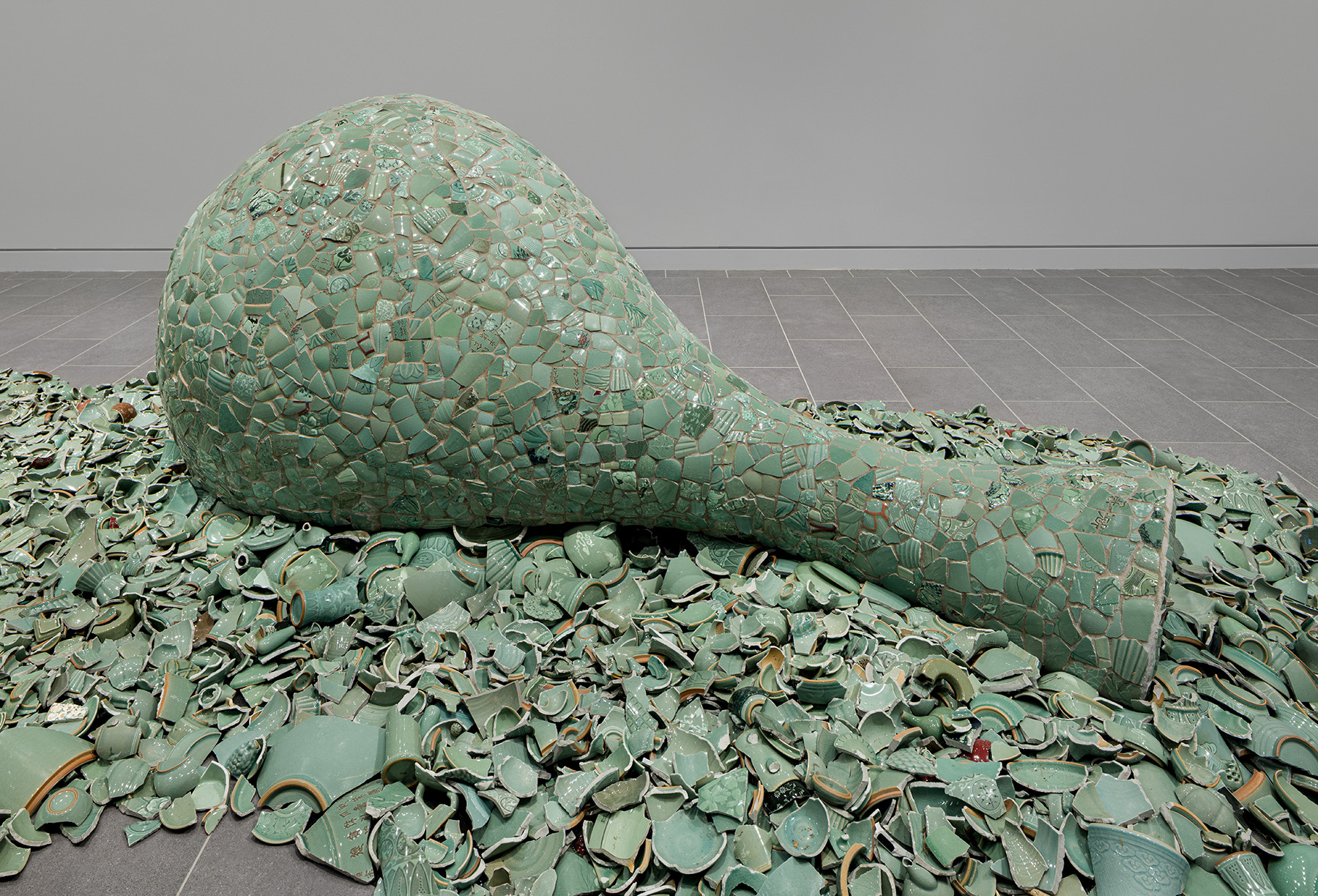
Installation view of “Celadon Landscape,” now on view at the Green-House at Green-Wood Cemetery in Brooklyn, NY. (Photo: Etienne Frossard)
The sculpture was produced with nearly two tons of fragments, donated to Shin by kilns in and around the Korean city of Icheon.
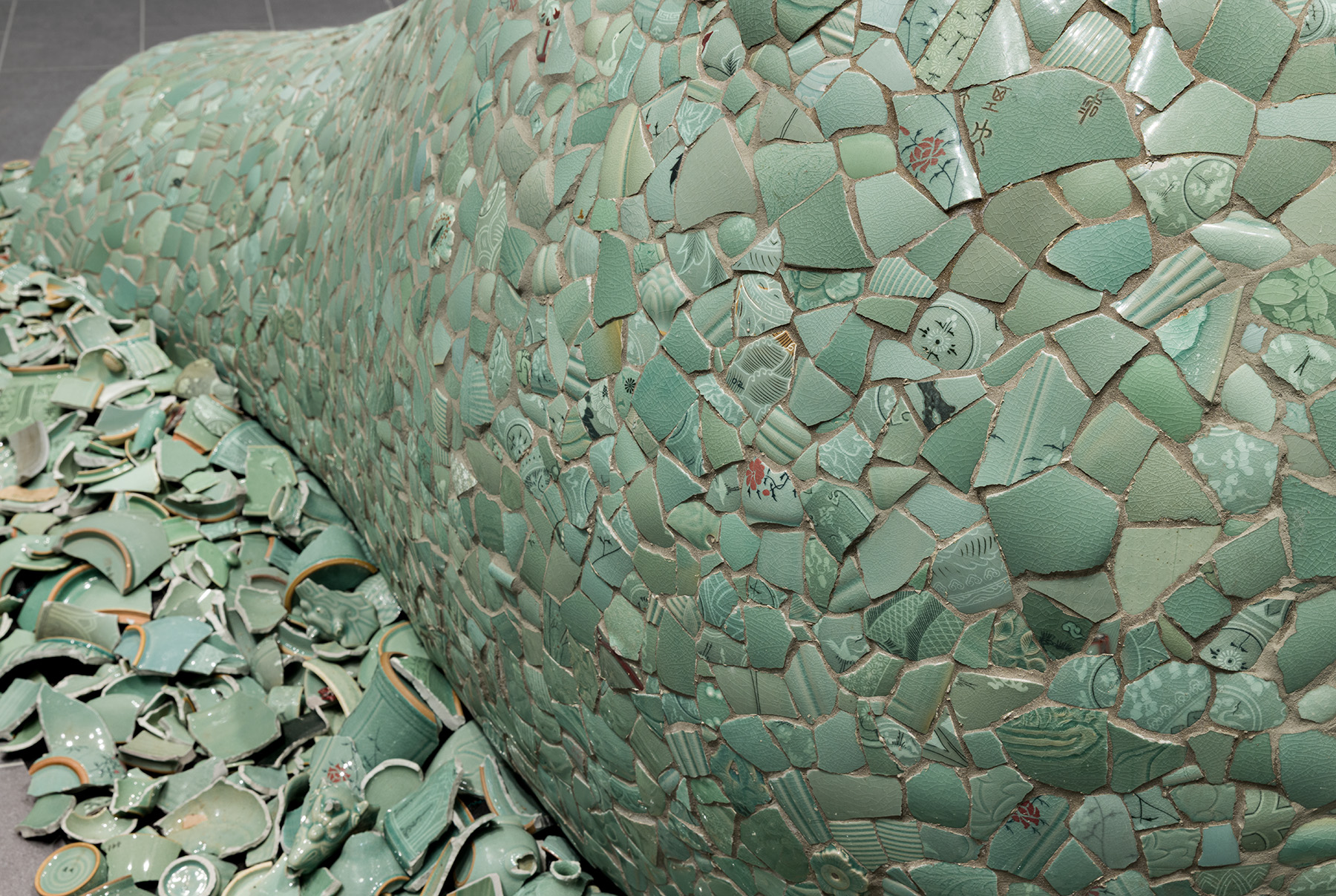
Installation view of “Celadon Landscape,” now on view at the Green-House at Green-Wood Cemetery in Brooklyn, NY. (Photo: Etienne Frossard)
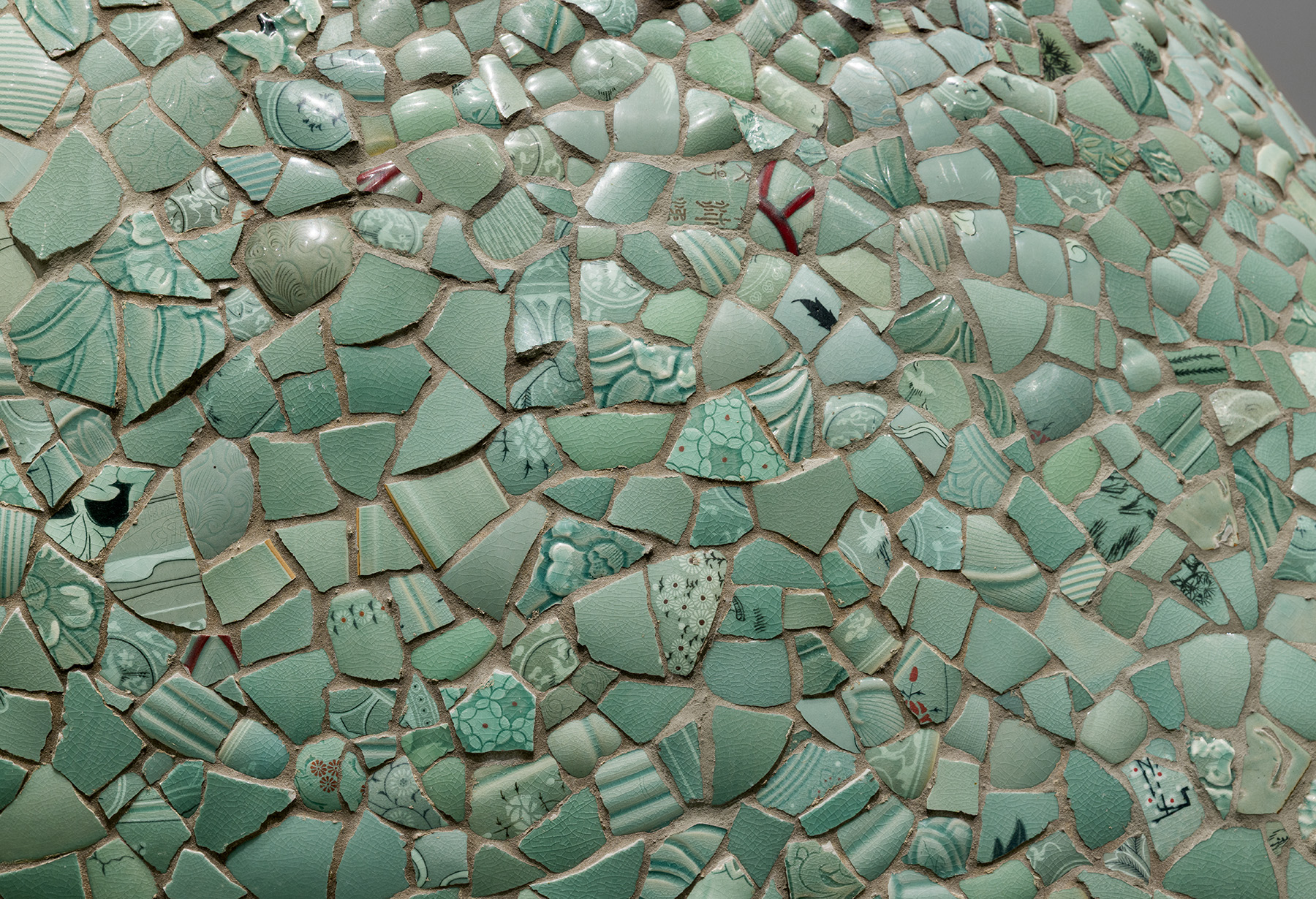
Installation view of “Celadon Landscape,” now on view at the Green-House at Green-Wood Cemetery in Brooklyn, NY. (Photo: Etienne Frossard)
New Yorkers can now enjoy Celadon Landscape, currently on view at Green-Wood Cemetery’s new Green-House through January 17, 2027.
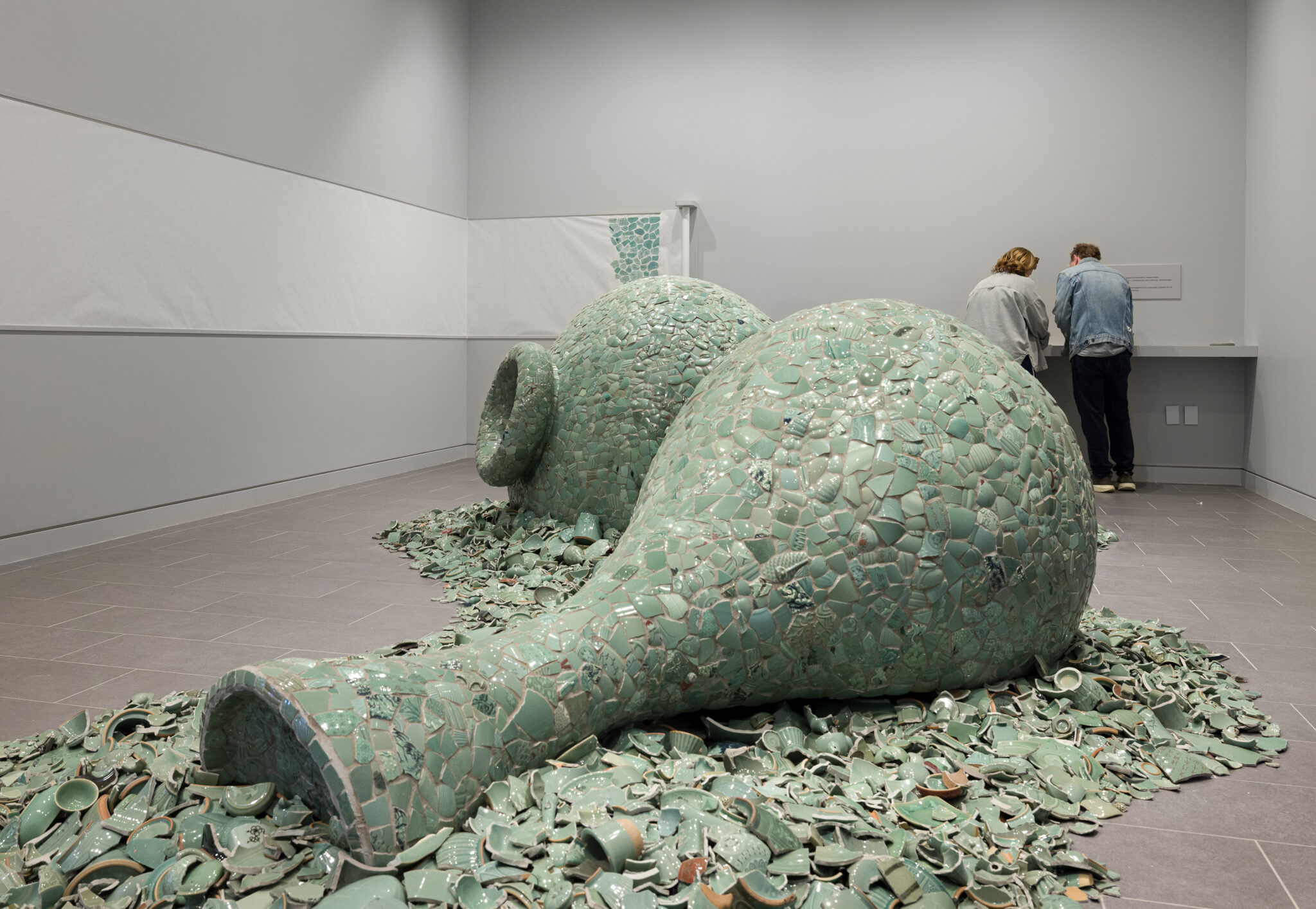
Installation view of “Celadon Landscape,” now on view at the Green-House at Green-Wood Cemetery in Brooklyn, NY. (Photo: Etienne Frossard)
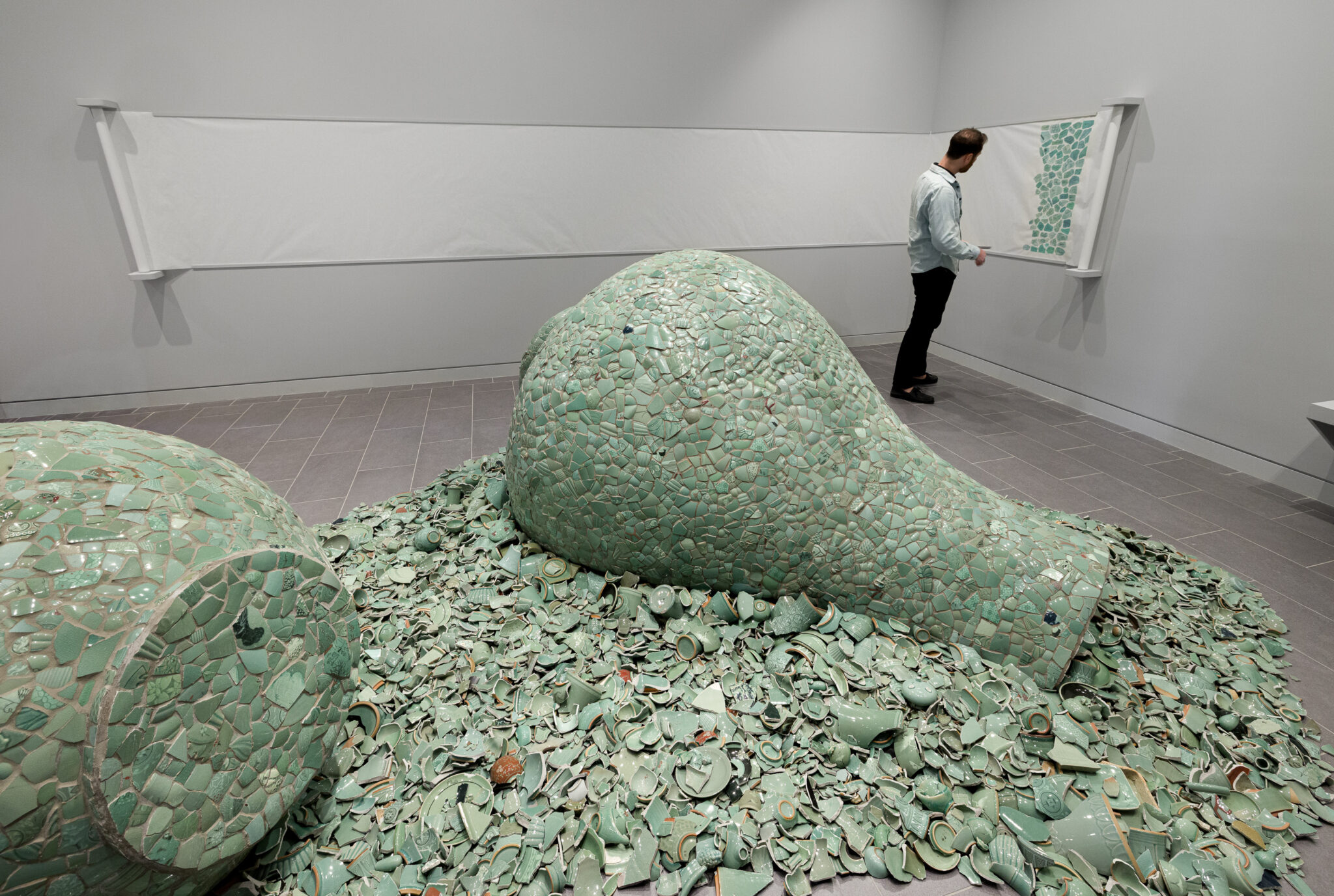
Installation view of “Celadon Landscape,” now on view at the Green-House at Green-Wood Cemetery in Brooklyn, NY. (Photo: Etienne Frossard)
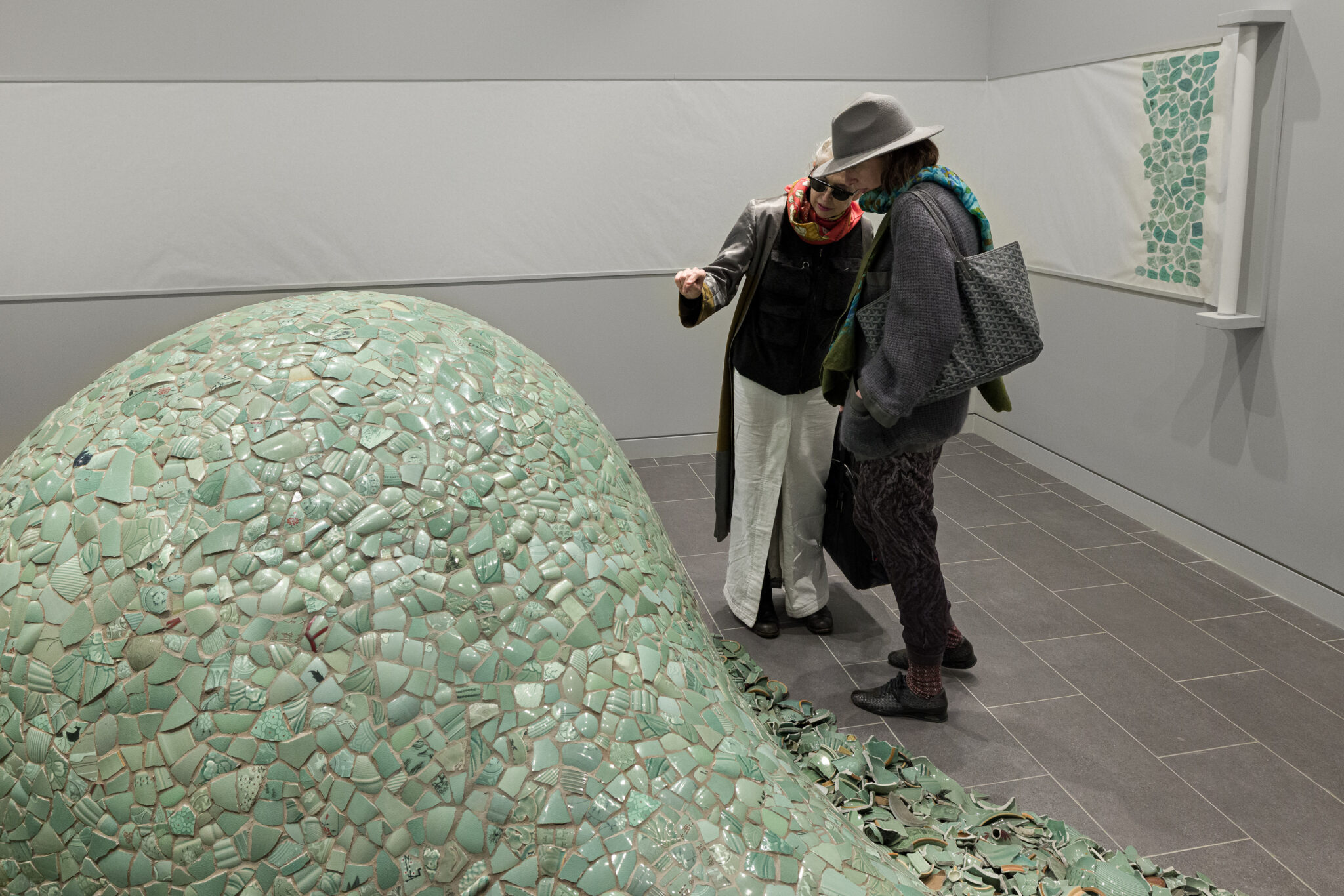
Installation view of “Celadon Landscape,” now on view at the Green-House at Green-Wood Cemetery in Brooklyn, NY. (Photo: Etienne Frossard)