

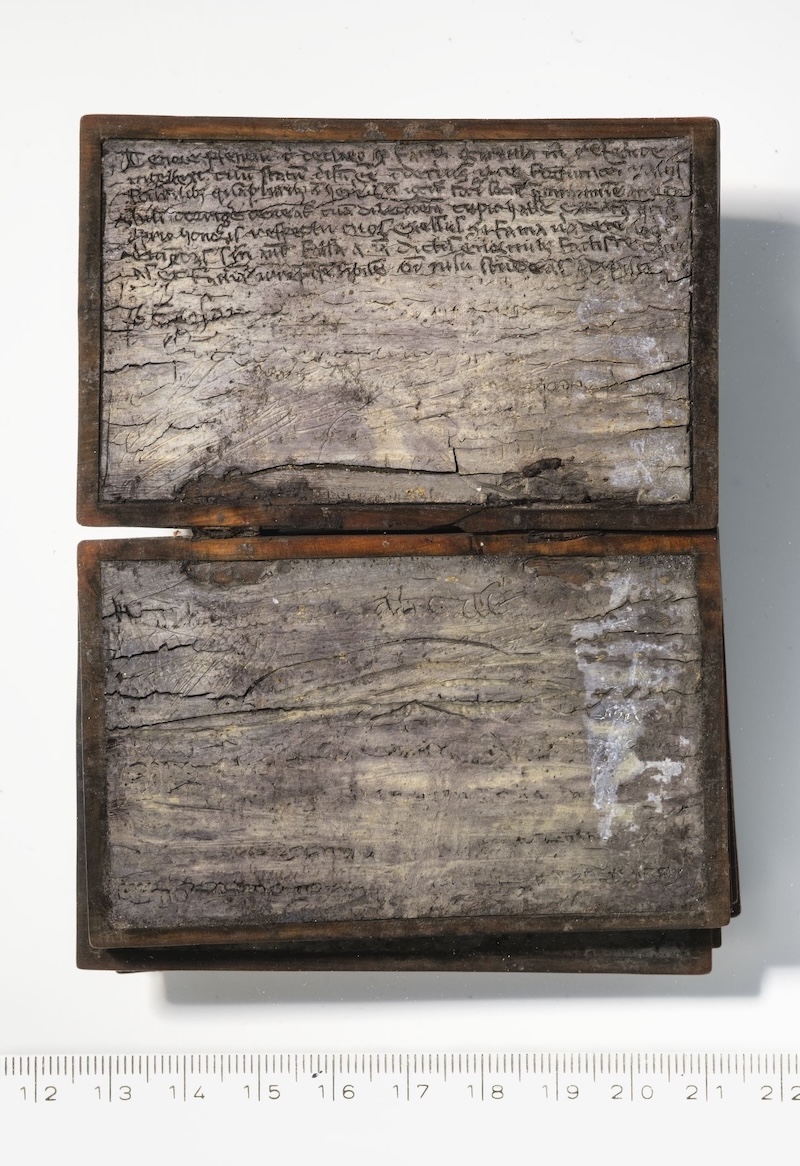
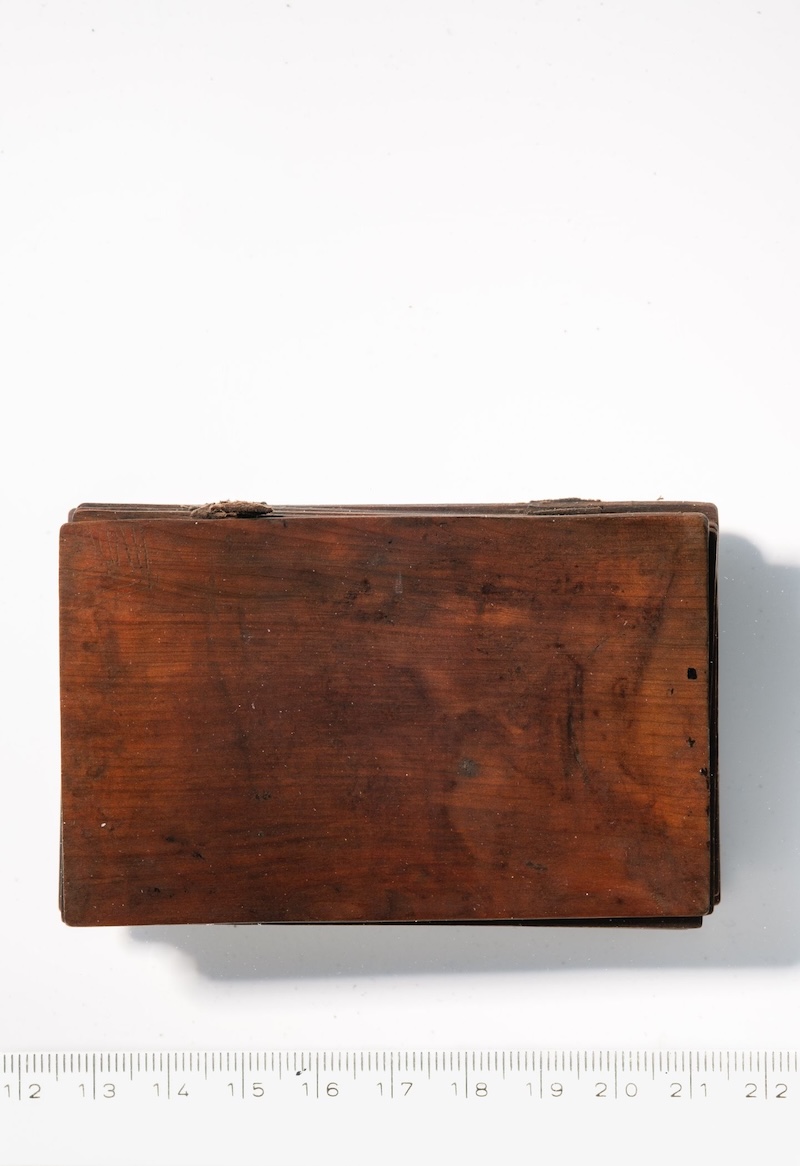
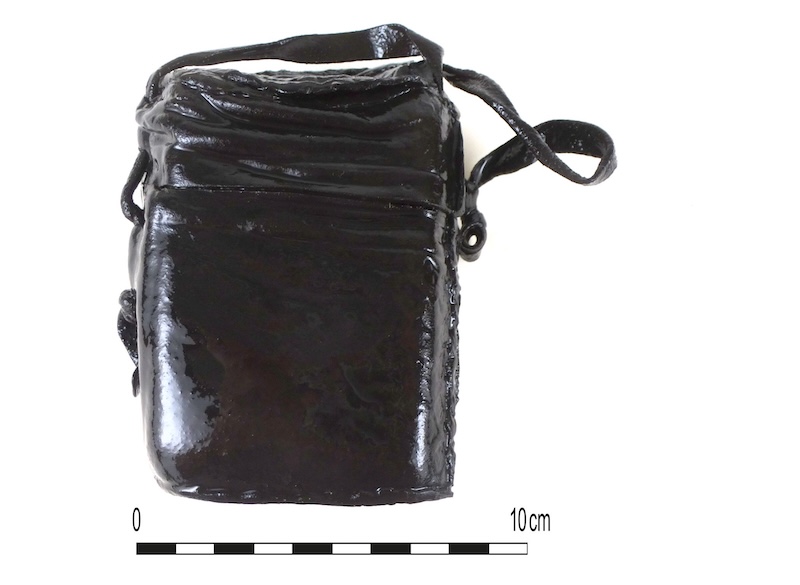
A small notebook made of wood, wax, and leather, and its accompanying ivory stylus, were unearthed from a latrine, or medieval toilet.
The book was unearthed in North Rhine-Westphalia, Germany. While performing excavation for a construction project in a historically important part of Paderborn, workers discovered five latrines. The notebook and stylus were found in one of them, among other objects like remnants of barrels, pottery, and fabric.
LWL conservator Susanne Bretzel explains, “I only had to clean the outside of the book, as the inner pages were so tightly bound that there was no dirt on them. The wood also hadn’t warped, so the wax is still intact and the writing itself is easily legible.”
The Regional Association of Westphalia-Lippe (LWL) has been overseeing the excavation and conservation. Dr. Barbara Rüschoff-Parzinger, an archaeologist and LWL’s head of cultural affairs, highlighted the importance and rarity of this discovery: “This is the only such find in all of North Rhine-Westphalia. It sounds strange, but for us archaeologists, latrines are almost always a treasure trove.”
Latrines are actually known to be very good at preserving objects. Objects tightly packed in damp, airtight soil are well-preserved for centuries. Though they may not seem it, they’re actually ideal spots for keeping artifacts like this safe for centuries. “However,” Dr. Rüschoff-Parzinger notes, “in no other case has the entire book been preserved as an archaeological find, as was the case here.”
Archaeologists have dated the artifact to the 13th or 14th century and believe it may have belonged to a merchant from medieval Paderborn who used it to jot down business transactions. “Merchants were educated people: unlike most people, they could both read and write,” says LWL archaeologist Dr. Sveva Gai. The writing is in Latin, which also suggests the book’s owner had an education and was of a higher class.
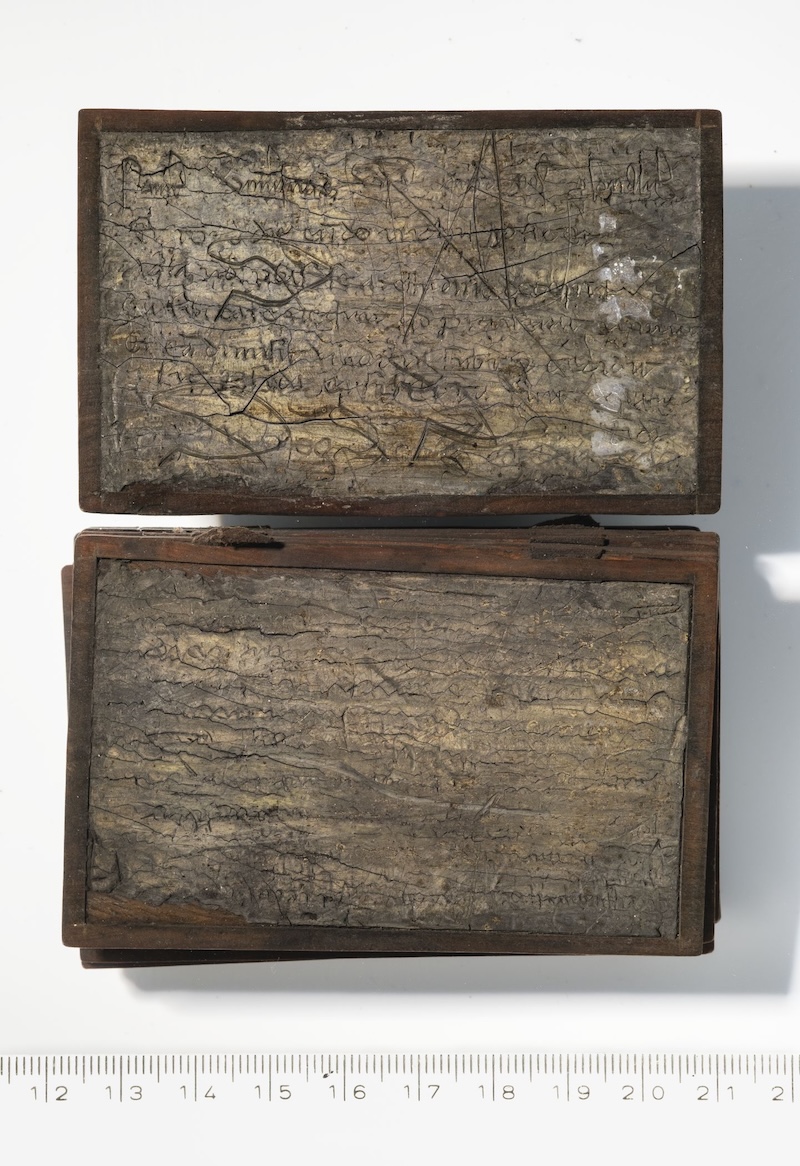
The notebook is very small—10 x 7.5 centimeters (about 4 x 3 inches) with the leather binding, 8.6 x 5.5 centimeters (about 3.4 x 2.2 inches) without, likely for portability, cost, and weight reasons. It’s made of 10 wooden tablets bound together to form pages. Each page contains writing, and excluding the first and last pages, the pages are all double-sided. Bretzel explains, “The stylus is pointed at one end to scratch the letters into the wax. The other end of the stylus was flat or spatula-shaped. This allowed the wax to be smoothed and the writing erased, making the tablet reusable.” In this notebook, experts can see the tracings of erased script, still legible.
The features of cursive writing helped archaeologists date the book to somewhere between 700 and 800 years ago. Even so, the Latin remains very difficult to read. Dr. Rüschoff-Parzinger says, “The text is not easy to decipher, even for experts in the field. Individual words are recognizable, but the transcription will take some time, as some words may have been corrupted by incorrect spellings.”
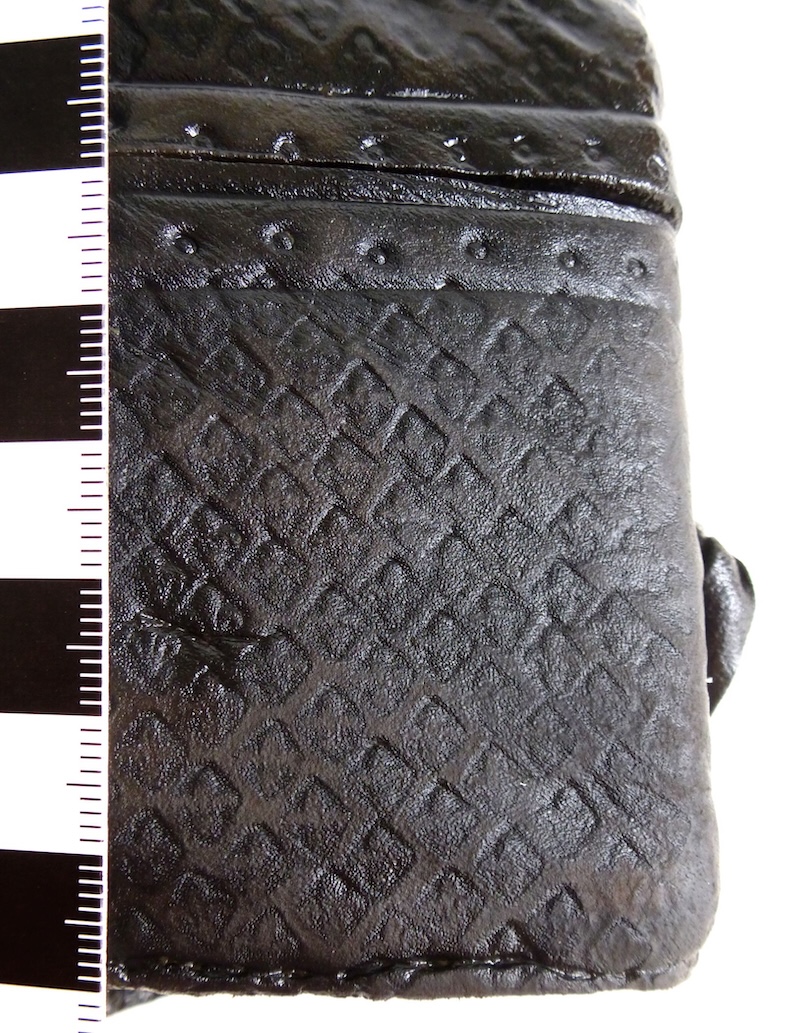
The leather binding in which the book was found is completely intact, apart from some loose threads. The leather is embossed with fleur-de-lis, rows of lilies that symbolized purity, royalty, and divinity in Medieval times.
This form of notebook building was common from the times of Ancient Greece through the Renaissance, until paper became more widely available and cheaper to produce. The question remains as to why and how the notebook got into the latrine, but experts like Dr. Gai say, “It could have fallen in there by accident.”
Researchers are prioritizing proper analysis of the exact type of material used so they can best figure out how to keep it safe. They must ask questions like “What wax or resin mixture is the wax made of? Were pigments added? What is its melting point? What type of wood is it?” The conservation and restoration process could take around a year, but after it’s over, the book will be put on display in the LWL Museum in the Imperial Palace in Paderborn.
A small notebook and its ivory stylus from the Middle Ages were unearthed in Paderborn, Germany, in excellent condition after being preserved for around 800 years in a latrine.
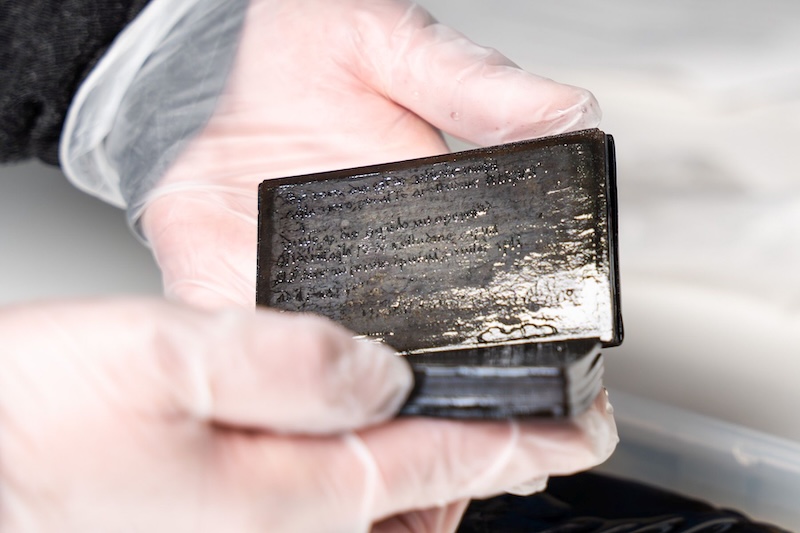
The latrine harbored the perfect conditions of being airtight, damp, and tightly packed for the notebook to be preserved.

The Regional Association of Westphalia-Lippe (LWL) is in charge of overseeing the notebook’s conservation and excavation.

The Latin writing indicates the notebook likely belonged to a merchant of the upper class, and the characteristics of the cursive date it back to the 13th or 14th century.
Fleur-de-lis embossing on the leather binding symbolized purity, royalty, and divinity in Medieval times.
The notebook measures 10 x 7.5 cm with the leather binding, 8.6 x 5.5 cm without, meant to be light, portable, and cheap.
Sources: Merchant’s notebook recovered in near-perfect condition from 800-year-old German latrine; 800-year-old medieval notebook found in German latrine still contains readable Latin writing
All photos via LWL.
Related Articles:
Archaeologists Discover 43,000 Ancient Egyptian “To-Do” Lists Offering a Rare Glimpse of Daily Life
Restoration Uncovers Stunning Art and Inscriptions of 2,000-Year-Old Egyptian Temple
40,000-Year-Old Symbols Carved in Bone May Reveal the Origins of Written Language
New Discovery of 3,000-Year-Old Babylonian Text Sheds Light on Women’s Roles in Ancient Society