

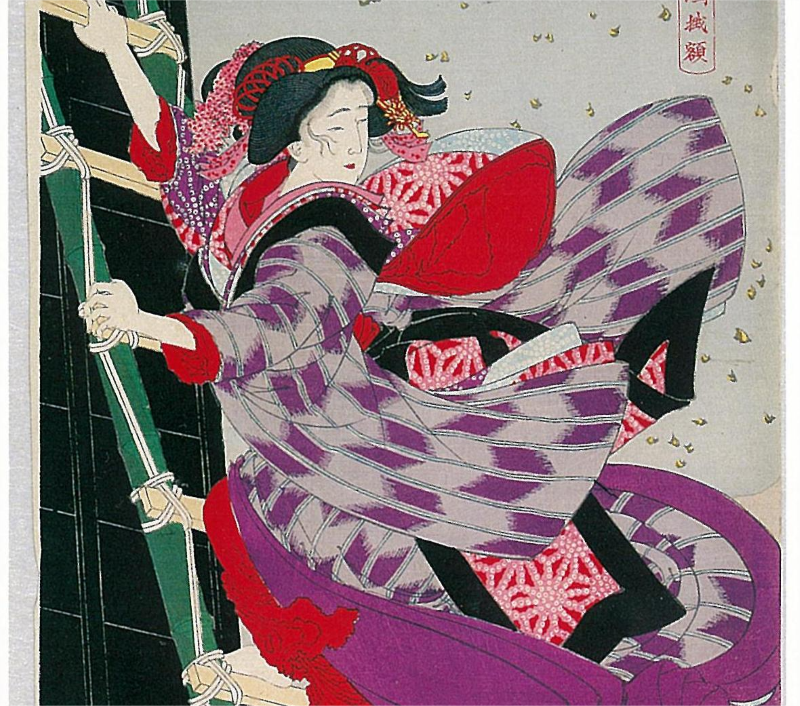
Oshichi (detail), ukiyo-e by Tsukioka Yoshitoshi, 19th century (Photo: Wikimedia Commons, Public domain)
Many cultures have stories of unrequited love and tragedy, but perhaps one of the more famous ones comes from Japan, where Yaoya Oshichi has become a household name. The teenage daughter of a greengrocer, she was swept up in controversy and paid for it with her life. Today, her story is known throughout Japan and is the subject of plays in traditional puppet theater.
Yaoya lived in the Hongō neighborhood of Edo at the beginning of the Edo period. She was around 16 years old in 1682 when she met and fell in love with temple page Ikuta Shōnosuke. Their encounter was anything but ordinary, as it happened during an event known as the Great Tenna Fire, in which thousands of homes were burned to the ground.
We all know that teenagers can sometimes make foolish decisions, especially when it comes to love. And, unfortunately for Yaoya, her decision cost her her life. She was so smitten and determined to find a way to see the temple page again that she tried to start another fire. According to the folktale, the authorities caught her in the act, and she was burned at the stake for her crimes.
If you are horrified that someone so young could be punished so severely, this is where Yaoya’s story becomes even more tragic. During the Edo period, children under the age of 16 could not face the death penalty. The judge who presided over her trial, attempting to save her, pointedly asked, “You must be 15 years old, aren’t you?” His question was not entirely unusual because the registration of family records was spotty during this period, so verifying an age was appropriate. Yaoya, not understanding the judge’s intentions, answered honestly, stating that she was actually 16. In doing so, she sealed her fate.
The judge has no choice but to sentence her to death, and thus, she was burned at the stake. Her story became famous when, three years after her tragic death, a Japanese poet wrote about the case in his book. Another 20 years later, her tale was transformed, with some dramatic liberties, into a play for puppet theater. In the late 18th century, three playwrights adapted her story into Date musume koi no higanoko, but in this version, she does not commit arson but instead climbs a fiery tower in order to ring an alarm bell so that the city gates will open and her love will be saved.
Interestingly, Yaoya was born in the year of the Fire Horse, which occurs approximately every 60 years. It is considered bad luck to be a girl born in that year, with the last year of the Fire Horse taking place in 1966.
Related Articles:
Chinese Folklore Gets Reimagined as High Fashion Couture Photo Shoots
19th-Century Japanese Woodblock Prints Imagine Cats in Place of Humans
Here’s What the Spookiest “Boogeyman” Looks Like in Different Countries
Kirigami: The Ancient Art of Paper Cutting and How Artists Are Keeping It Alive