

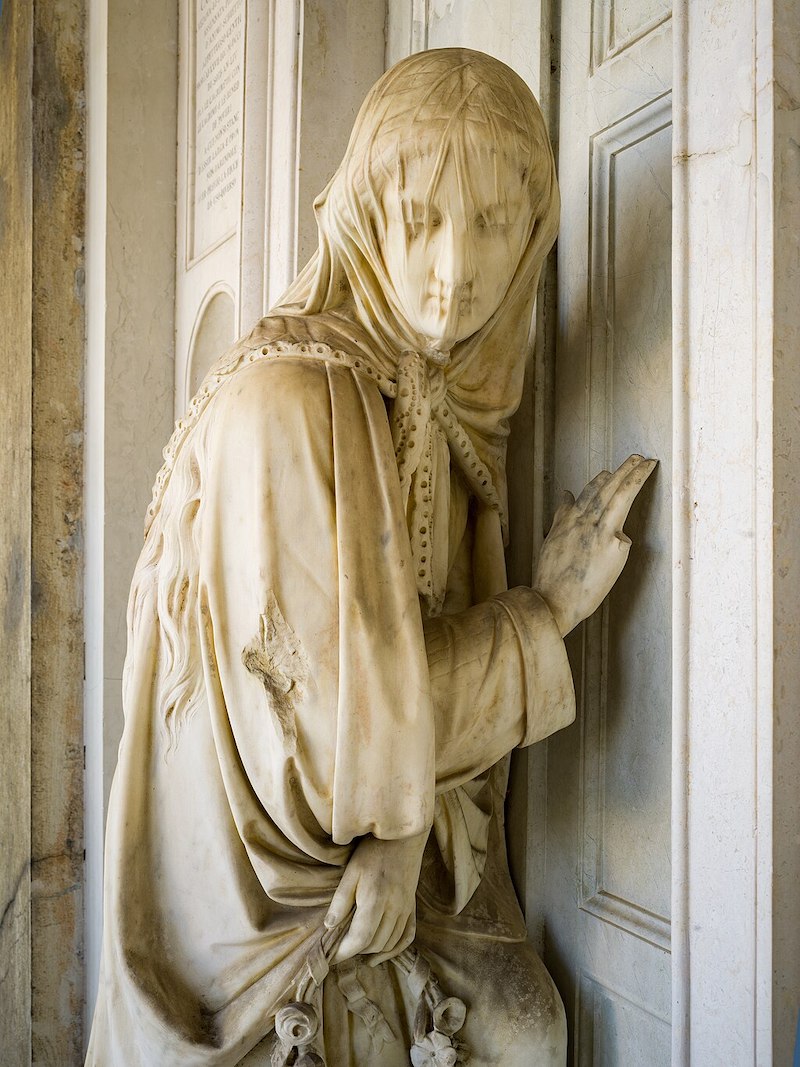
Funerary monument of the Dossi Rampinelli Spalenza family by Giovanni Battista Lombardi 1856 in the Monumental cemetery in Brescia. (Photo: Wikimedia Commons, CC BY-SA 1.0)
Marble is known for its heavy, sturdy qualities. But in the right artist’s hands, it can look as light as a feather. One marble sculpture exemplifies this unique characteristic, capturing attention for its startling realism. At first glance, a sheer veil appears to rest lightly over a young woman’s face. The folds are soft, and light gathers along the edges and fades gently into shadow. Nothing about it suggests weight or density. Yet every delicate crease is carved from solid stone.
The work is linked to Giovanni Battista Lombardi, a 19th-century Italian sculptor known for his refined funerary monuments. Lombardi worked within a long tradition of artists who pushed marble beyond its limits, shaping it into forms that seem to breathe. In this piece, the woman’s head tilts slightly downward, her gaze calm and inward. The veil clings closely to her features, softening the contours while revealing the structure beneath with remarkable clarity.
To create this effect, Lombardi relied on precision rather than excess. He gradually reduced the marble’s thickness across the face and veil, allowing subtle shifts in depth to control how light moves across the surface. Raised areas catch brightness. Slight recesses hold shadow. These small variations convince the eye that the veil is thin and pliable.
There is no true transparencyin the scultpure. Rather, the illusion depends on contrast, polish, and restraint. Instead, Lombardi lets the interplay of light and form do the work. The result feels immediate and convincing.
Centuries later, Lombardi’s illusion remains compelling, as the sculpture does not rely on spectacle—it relies on material and light. In transforming stone into something that looks tender and alive, Lombardi demonstrates how far an artist can push a single block of marble.
A 19th-century veiled marble sculpture makes solid stone look like soft, flowing fabric through astonishingly precise carving.
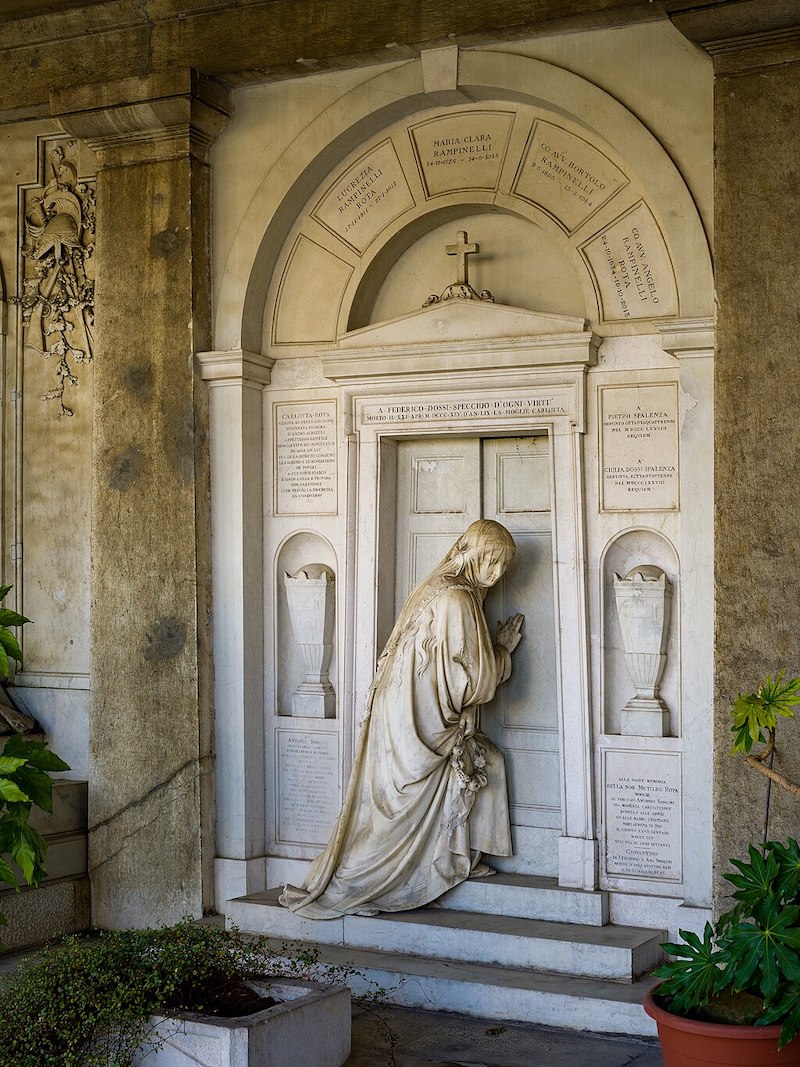
Funerary monument of the Dossi Rampinelli Spalenza family by Giovanni Battista Lombardi 1856 in the Monumental cemetery in Brescia. (Photo: Wikimedia Commons, CC BY-SA 1.0)
Centuries later, this veiled marble still mesmerizes with its lifelike folds and subtle light.
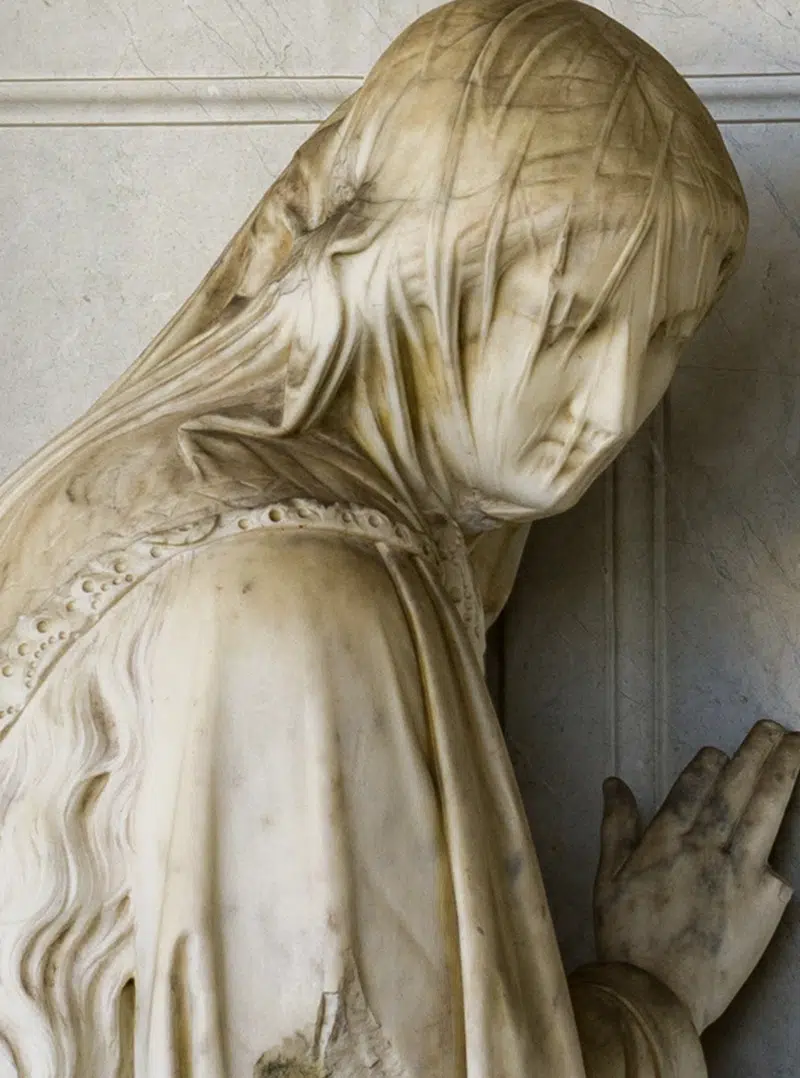
Detail of funerary monument of the Dossi Rampinelli Spalenza family by Giovanni Battista Lombardi 1856 in the Monumental cemetery in Brescia. (Photo: Wikimedia Commons, CC BY-SA 1.0)
Source: Unbelievable craftsmanship — marble that looks like sheer, see-through fabric
Related Articles:
Sculpture Bought for $6 and Used as Doorstop Is Actually 18th-Century Marble Bust Worth $3M
Museum Shows What Happens When You Let Visitors Touch Marble Sculptures
The Mysterious History of the Marble ‘Venus de Milo’ Statue
Artist Compresses Classical Sculptures Into Small Marble Cubes