

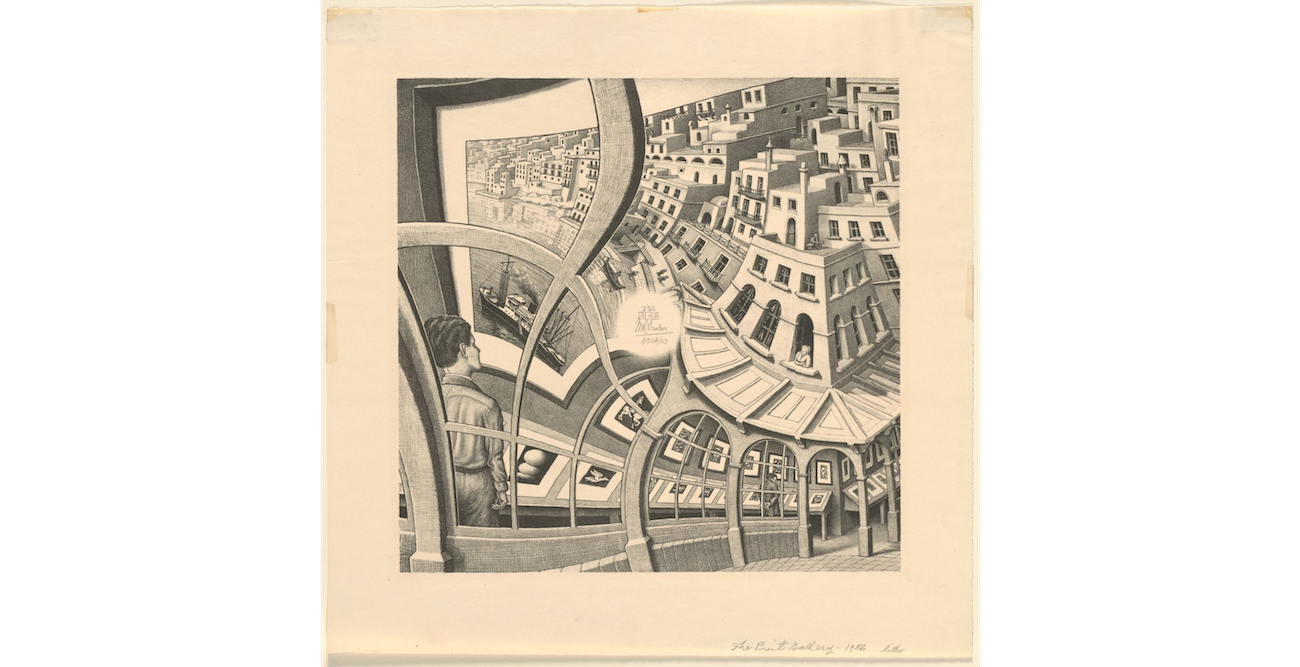
“Print Gallery,” 1956. (Photo: Courtesy the M.C. Escher Company B.V.)
For most of his life, M.C. Escher was largely overlooked by the art world. This can perhaps be attributed to the Dutch artist’s singular—though idiosyncratic—style, which was rooted in mathematics, optical illusions, geometry, and so-called “impossible objects.” But, for those very same reasons, he also attracted wide popular interest beyond art institutions, a reputation that has solidified him as one of the greatest graphic artists of the 20th century. Now, thanks to the Boston Public Library, anyone can explore dozens of Escher’s spellbinding prints via a sprawling online database.
The digitized collection features Escher’s lithographs, each of which seem to reflect the world through a funhouse mirror. Every composition is playful, warped, immersive, and, because of that, demands an attentive eye to be fully enjoyed, challenging us to encounter familiar settings in a new light.
Convex and Concave from 1955, for instance, depicts a strange, labyrinthine structure, traversed by an intriguing cast of characters. One man balances precariously on a ladder, while another plays a trumpet from a window that appears flat rather than three-dimensional. In this piece, Escher betrays his enduring fascination with perspective, distorting architectural conventions with unusual angles, ornamentation, and details.
Another central theme within Escher’s practice was duality, which he often explored through illusions. Day and Night is perhaps one of his most well-known works, showcasing a swarm of both black and white geese flying in opposite directions. As they soar through the sky, the geese bring with them darkness and light, splitting the composition in two as if reminding us, visually, of the juxtaposition between different points in the day. Notably, as the eye travels down the canvas, the geese slowly disintegrate, merging into the fields over which they fly. This sort of “blending” is a common technique in Escher’s work, resulting in captivating and unexpected compositions that encourage active—and continued—engagement.
But Escher didn’t only focus on optical illusions or architectural perspective. He also produced patterned works, such as Development I from 1937. Here, Escher organizes a series of black and white lizards into an interlocking grid. As the pattern flows toward the edges of the canvas, however, forms begin to blur and disappear, transforming instead into standard checkers. When it comes to these repeating motifs, the artist seems to have a preference for animal imagery, often returning to fish, birds, or both.
During his lifetime, Escher created some 450 lithographs, woodcuts, and wood engravings, and more than 2,000 drawings and sketches. Aside from working as a graphic artist, he also illustrated books, designed carpets and banknotes, stamps, murals, and intarsia panels, among other objects. Since his death in 1972, his oeuvre has gained even wider recognition, standing as remarkable achievements in “impossible” art.
Explore more of Escher’s works via the Boston Public Library’s digital commonwealth collection.
The Boston Public Library has digitized dozens of spellbinding prints by Dutch artist M.C. Escher, whose primary interests lay in mathematics, optical illusions, and so-called “impossible objects.”
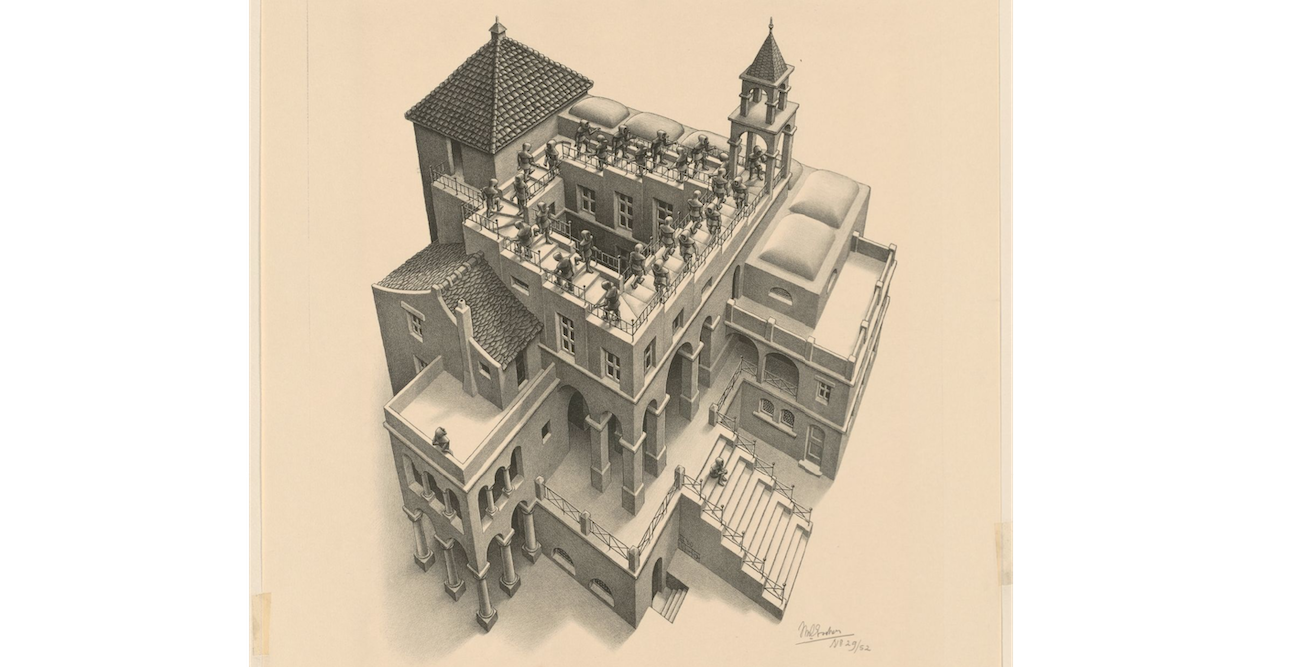
“Ascending and Descending,” 1960. (Photo: Courtesy the M.C. Escher Company B.V.)
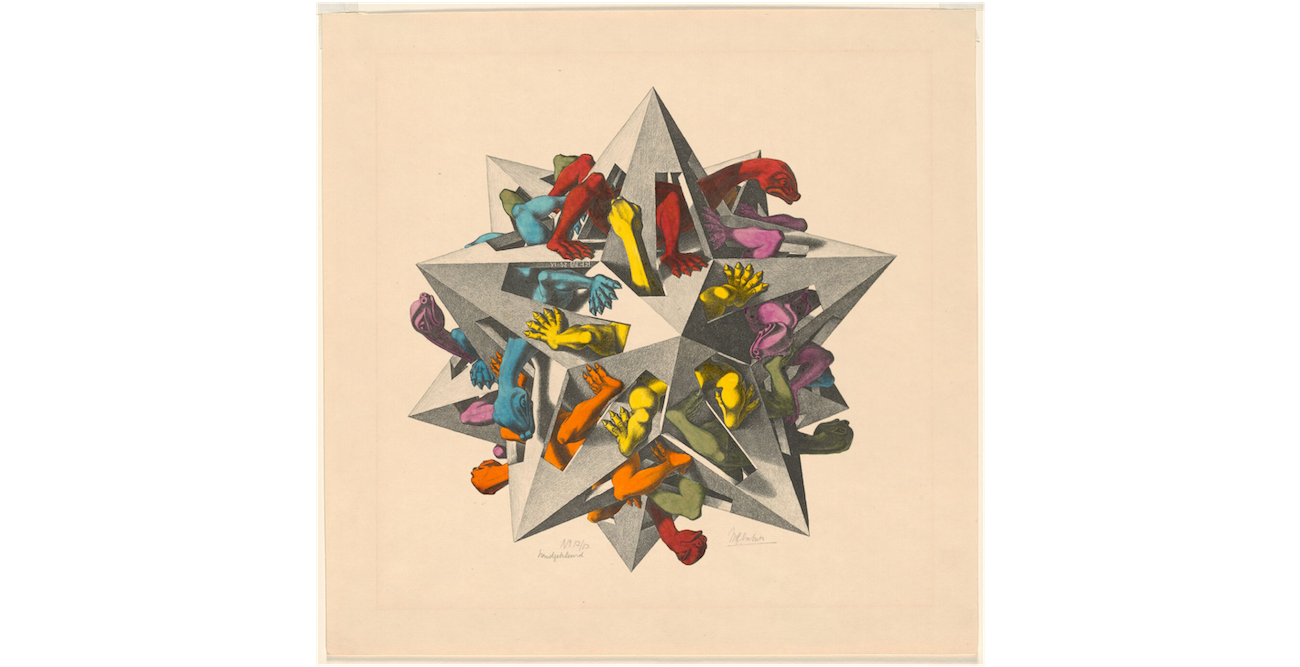
“Gravity,” 1952. (Photo: Courtesy the M.C. Escher Company B.V.)
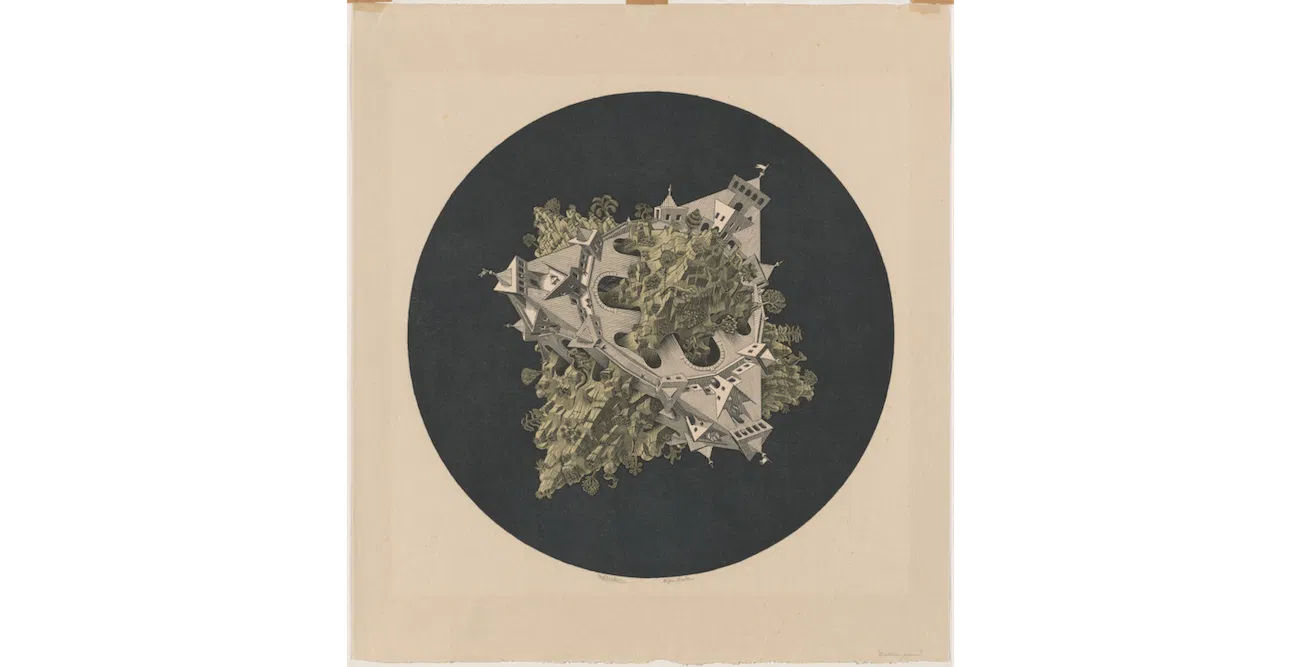
“Double Planetoid,” 1949. (Photo: Courtesy the M.C. Escher Company B.V.)
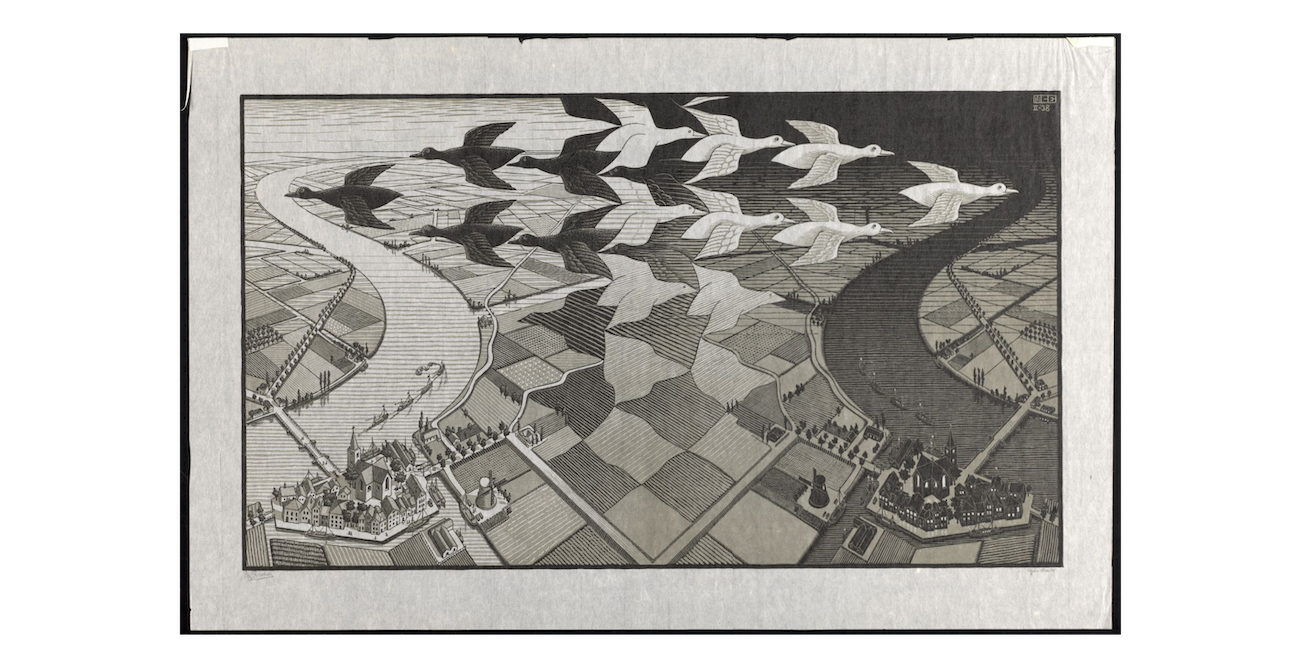
“Day and Night,” 1938. (Photo: Courtesy the M.C. Escher Company B.V.)
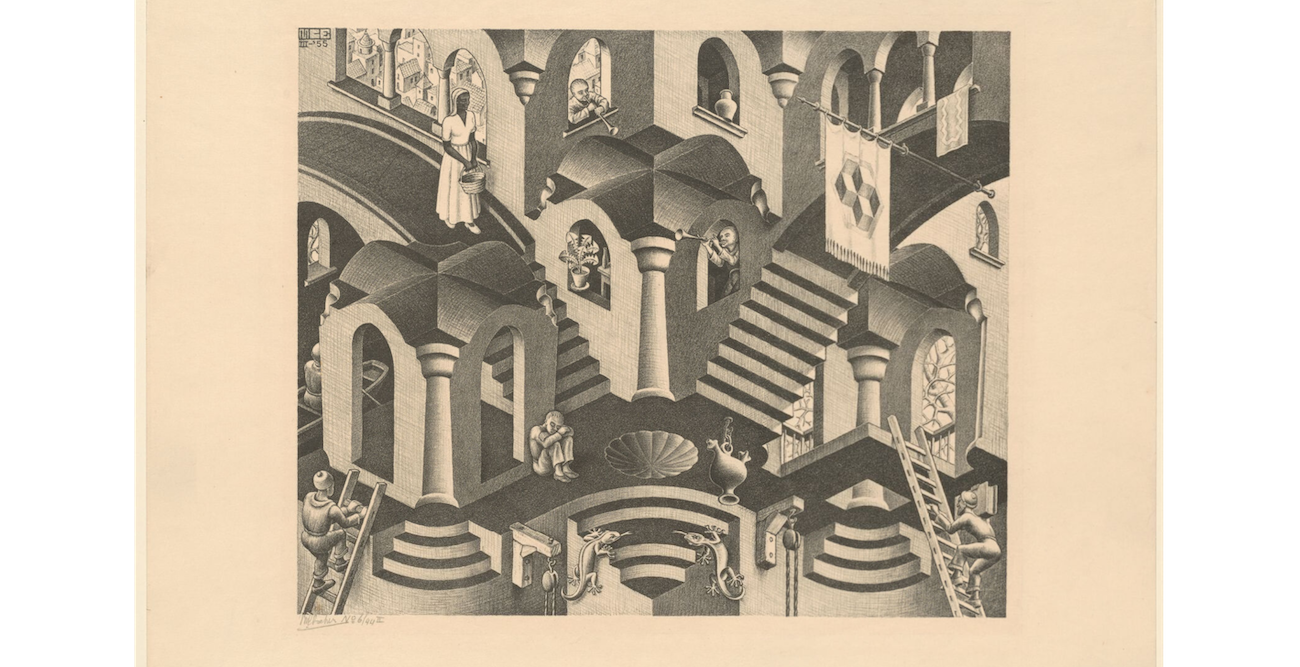
“Convex and Concave,” 1955. (Photo: Courtesy the M.C. Escher Company B.V.)
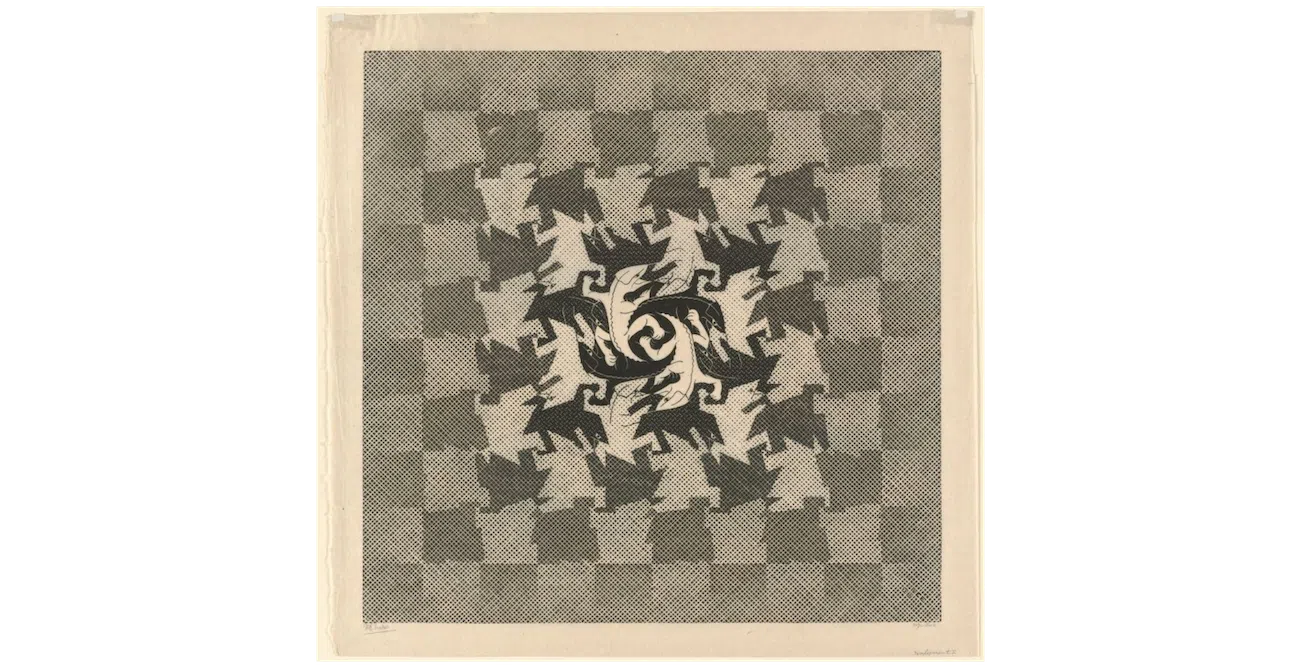
“Development I,” 1937. (Photo: Courtesy the M.C. Escher Company B.V.)
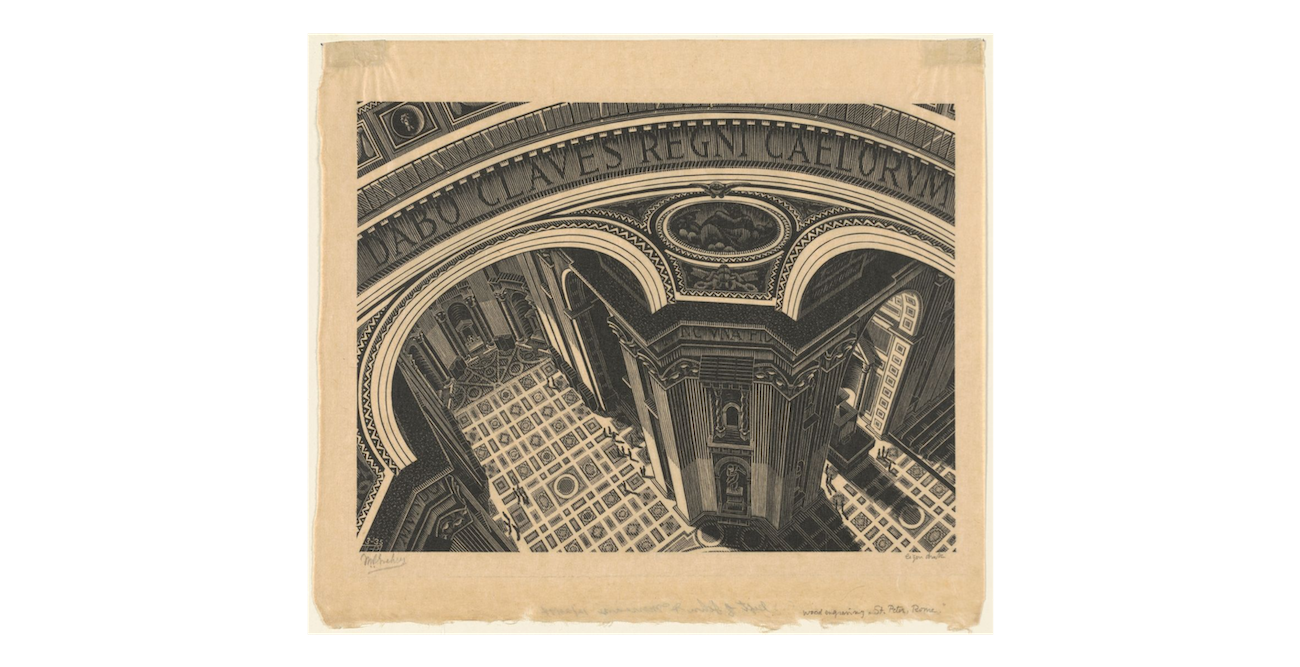
“Inside Saint Peter’s,” 1935. (Photo: Courtesy the M.C. Escher Company B.V.)
Sources: M.C. Escher: Biography; Dozens of M.C. Escher Prints Have Been Digitized & Put Online by the Boston Public Library
Related Articles:
Explore Hundreds of Pre-1800s Occult Texts With This Sprawling Online Database
Dive Into Over 10,000 Historical Children’s Books Thanks to This Fascinating Database
The Undecipherable Voynich Manuscript Can Be Viewed Online in Its Entirety