

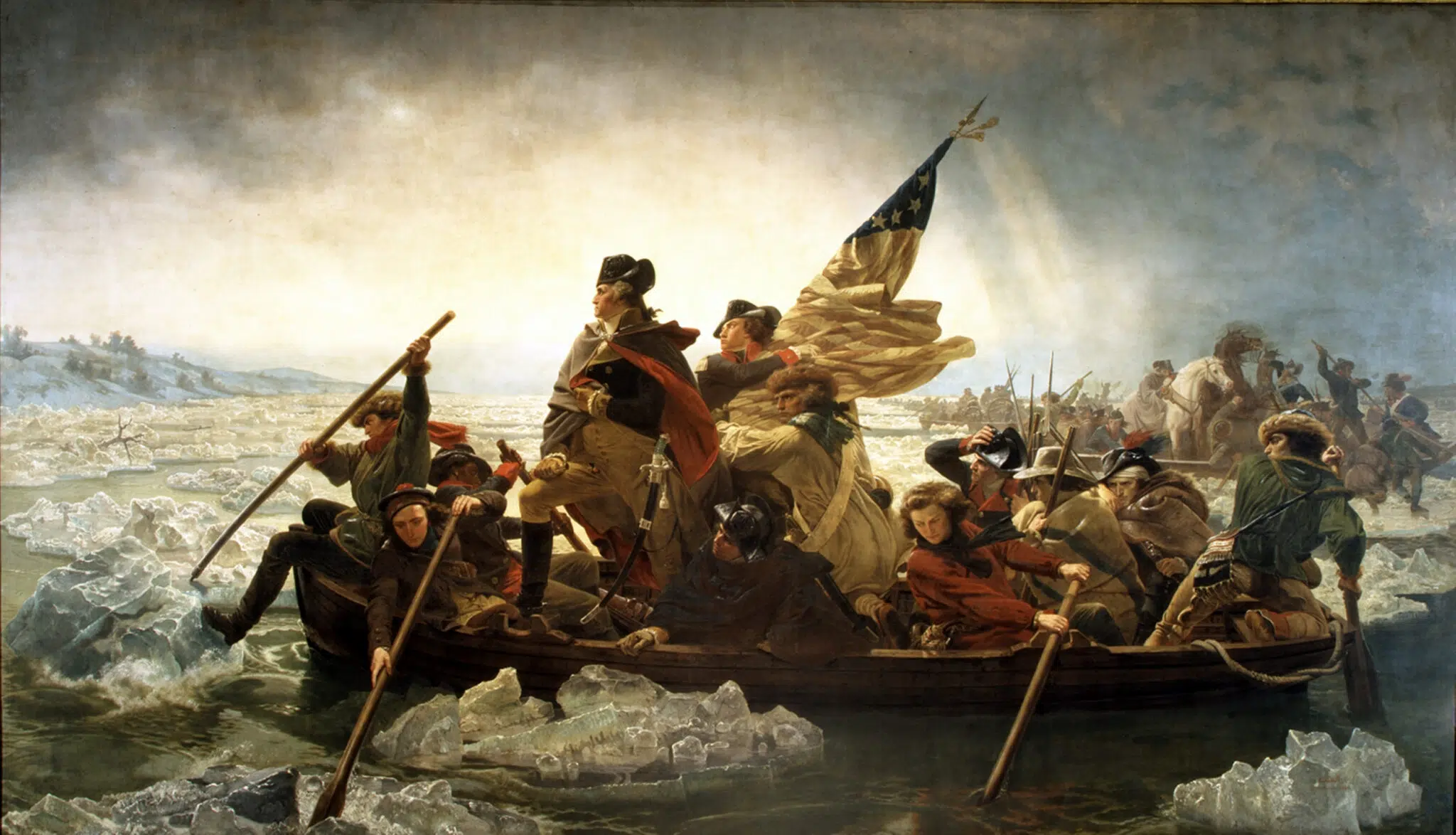
Emanuel Leutze, “Washington Crossing the Delaware,” 1851. (Photo: The Metropolitan Museum of Art, Public domain)
Throughout his illustrious, decades-long career, filmmaker Ken Burns has produced countless documentaries focused on the United States and its history. But, even with all his expertise, it took him nearly 10 years to complete The American Revolution, a six-part docuseries that recently premiered on PBS on November 16. Not only does the project stand as one of Burns’ most ambitious, but it also offers a stunningly comprehensive glimpse into the war that birthed an independent nation.
Co-directed by Sarah Botstein and David Schmidt, and written by Geoffrey C. Ward, The American Revolution is a granular record of its eponymous subject, spanning 12 hours of footage. Unlike his award-winning 1990 series The Civil War or his 2017 documentary The Vietnam War, however, Burns and his team couldn’t rely on photographs to visualize the story of the American Revolution, which unfolded from 1775 to 1783.
“It’s just an incredibly difficult war, and the lack of photographs makes it seem cartoonish,” Burns admitted in an interview with Smithsonian. “The sacrifices are different than watching somebody fall as they’re climbing up the beaches of Normandy on D-Day. But it is, of course, all of that and much more.”
To accommodate that fact, the series pairs an uncompromising attention to detail with a more kaleidoscopic reconstruction of the war, as told through interviews with scholars and researchers; archival materials like maps, speeches, and correspondence; and, above all, artful reenactments of key battles and moments during the war. These scenes were all shot at actual historical locations, creating a clear link between the American Revolution and the landscapes over which it unfolded. Throughout, Burns also exploits close-ups of soldiers and drone shots of battlefields to masterful effect, avoiding the “cartoonishness” typically associated with historic reenactments.
“I normally eschew reenactments, but in this case, it was really clear [we were] going to have to do them,” Burns added. “We’re not asking [the re-enactors] to re-enact this battle—we’re filming them at dawn or dusk in a very intimate, impressionistic fashion, so that we can collect a critical mass of imagery that can then be used with the [archival] paintings, with the maps, with the commentary, with the first-person voices, to help bring everything alive.”
Perhaps what distinguishes The American Revolution the most is its fascination with lesser-known facts and figures from the war. The documentary resurrects John Greenwood, for instance, who was 14 years old when he joined the patriot cause, as well as Margaret Corbin, whose husband was killed at the Battle of Fort Washington in upper Manhattan. When she took over the battery after his death, Corbin proved so effective that the German fire was eventually directed at her, according to Burns.
Other sections focus on Indigenous soldiers and civilians, enslaved and free African Americans, and revolutionary women, giving voice to those often overlooked in historical accounts. The result is a multidimensional overview of the Revolutionary War, exploring both the virtues and contradictions behind America’s founding.
“We’re in a moment that people have described as existential, certainly a moment of division,” Burns said. “Maybe there could be some understanding that during this revolutionary period, we were more divided than we are now. And maybe by going back and reinvesting some time in this origin story, we’ll be able to put the ‘us’ back in the U.S.”
The American Revolution debuts just in time for America’s 250th anniversary, which will be celebrated throughout 2026. The documentary also features a classroom component, educational resources, and collaborations with the National Constitution Center, the Museum of the American Revolution, and the Colonial Williamsburg Foundation, among others.
To begin watching The American Revolution, visit the dedicated series page on PBS.
Filmmaker Ken Burns’s new six-part, 12-hour docuseries, The American Revolution, is now streaming via PBS.
Sources: The American Revolution, a New Film From Ken Burns, to Premiere November 16, 2025; Ken Burns Says His New Documentary Forced Him to Revisit Everything He Thought He Knew About the American Revolution; Ken Burns’ ‘The American Revolution’ explores the beginnings of the nation’s democracy; Ken Burns’ ‘American Revolution’ will make you think differently about U.S. history
Related Articles:
Local Historians Unveil the Oldest Known Photo Taken in Colorado
Expedition Recovers Treasure Worth Over $1 Million From Shipwreck off Florida Coast
Rare New England Coin From 1652 Found in an Old Cabinet Sells for $2.52 Million at Auction