

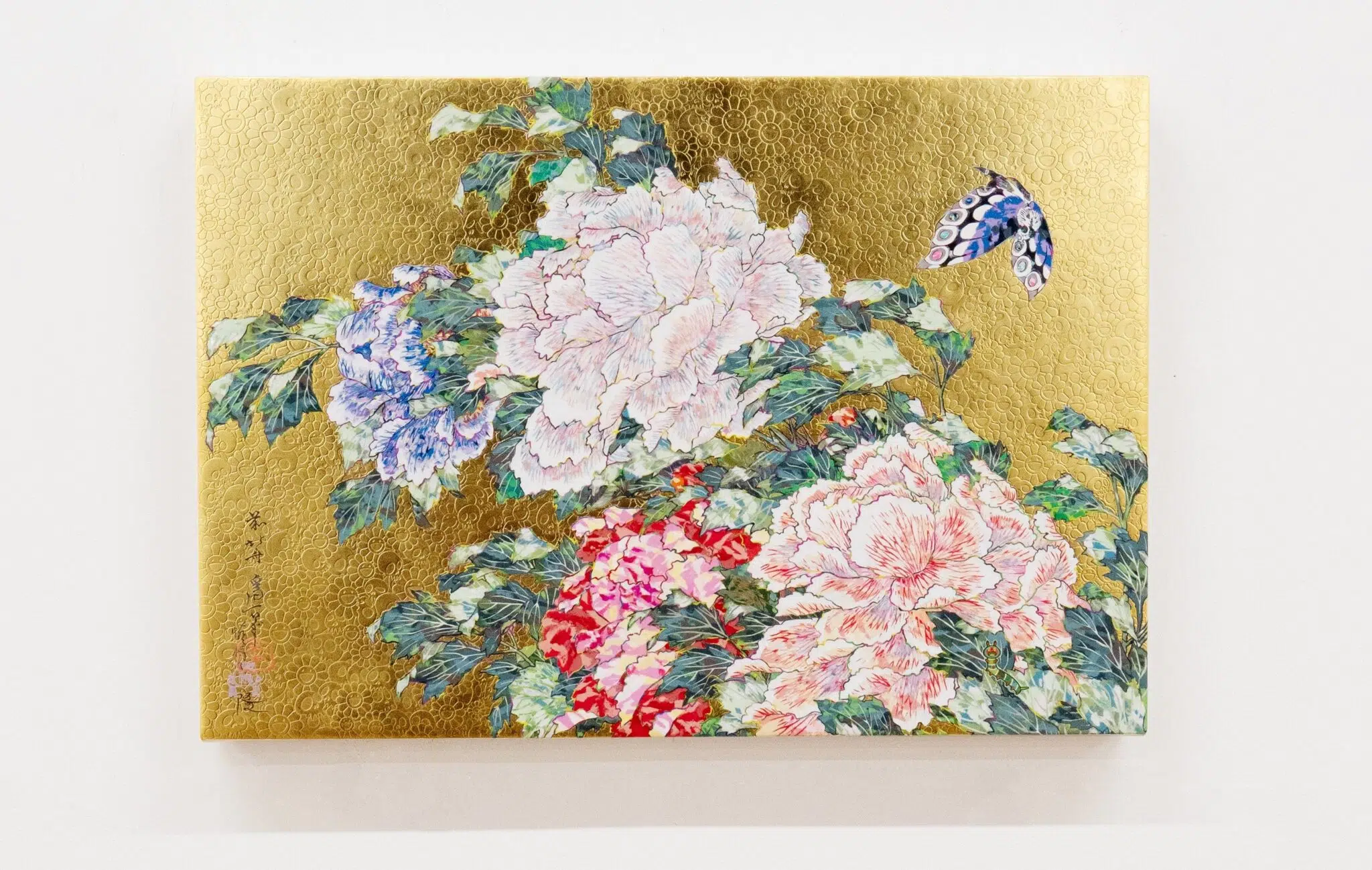
Takashi Murakami, “Katsushika Hokusai’s ‘Peonies and Butterflies’ – SUPERFLAT,” 2025-2026. Acrylic and gold leaf on canvas mounted on aluminum frame. (©︎2025-2026 Takashi Murakami/Kaikai Kiki Co., Ltd. All Rights Reserved. Courtesy Perrotin)
For Takashi Murakami, visiting Claude Monet’s house and gardens in Giverny wasn’t simply a walk in the park. It was also an artistic exercise, prompting him to meditate upon Japan’s art historical relationship with Europe—and vice versa. These reflections are at the heart of Hark Back to Ukiyo-e, the artist’s newest solo exhibition at Perrotin in Los Angeles.
Across a suite of 24 paintings, Murakami revisits Japanese ukiyo-e prints and how they influenced European Impressionism throughout the late 19th and early 20th centuries. It was around this period that Japan had finally opened itself up after more than 200 years of self-isolation, resulting in increased trade and international exchange with the rest of the world. Suddenly, European artists had unprecedented access to Japanese art objects, including the ukiyo-e prints that would come to inspire the japonisme movement. Alongside Edgar Degas and Toulouse-Lautrec, Monet was one of Europe’s earliest admirers of ukiyo-e, Japanese art, and, as Murakami highlights, bijinga.
Part of the ukiyo-e genre, bijinga focused on women—notably courtesans, geishas, and iconic attendants of Edo teahouses—and presented them as “alluring figures,” according to Perrotin. For Impressionist artists like Monet, these bijinga works had much to offer: they incorporated novel compositions, exotic costumes, and erotic qualities, a lot of which surfaces throughout Monet’s own canvases. Murakami muses upon this cultural conversation in Hark Back to Ukiyo-e, which reimagines monumental bijinga paintings in tandem with Impressionist masterpieces.
One section, for instance, showcases Murakami’s own copy of Monet’s 1875 portrait of his first wife, Camille, titled Woman with a Parasol. Murakami’s interpretation doesn’t stray far from Monet’s, but he pairs it with 12 enlarged versions of ukiyo-e prints by Kikukawa Eizan and his teacher, Utamaro. Taken together, these works trace an art historical trajectory, revealing how Monet lifted elements of ukiyo-e like sensual outlines, parasols viewed from below, windswept skirts, and cherry blossoms.
“As Murakami has pointed out, copying has a long history in Japan,” the gallery writes of the exhibition. “By revisiting key works from the past, he is hoping to learn from his predecessors, in the process clarifying for himself the chain of relationships from ukiyo-e to modern abstraction.”
Another section is a bit more familiar for Murakami fans, featuring his signature superflat aesthetics. This time, though, the artist complements his “kawaii,” illustrative characters with Monet’s Impressionism. The juxtaposition between both stylistic voices suggests a sort of continuity, underscoring that cultural exchange still exists within contemporary art.
This isn’t the first time that Murakami has played with art history. In 2024, he staged Japanese Art History à la Takashi Murakami at Gagosian’s London gallery, with paintings remixing ancient Japanese art. The exhibition challenged the sanctity of national art by infusing them with pop cultural references, ranging from the artist’s Mr. DOB mascot to his graphic, anime-inspired color palettes. As with Hark Back to Ukiyo-e, the show also considered how European and Japanese aesthetics have mutually impacted one another, especially following the Edo Period (1603-1868).
Hark Back to Ukiyo-e: Tracing Superflat to Japonisme’s Genesis will be on view at Perrotin Los Angeles from February 14 through March 14, 2026.
In his newest solo exhibition, Hark Back to Ukiyo-e, Takashi Murakami explores how Japanese art influenced European Impressionism—and vice versa.
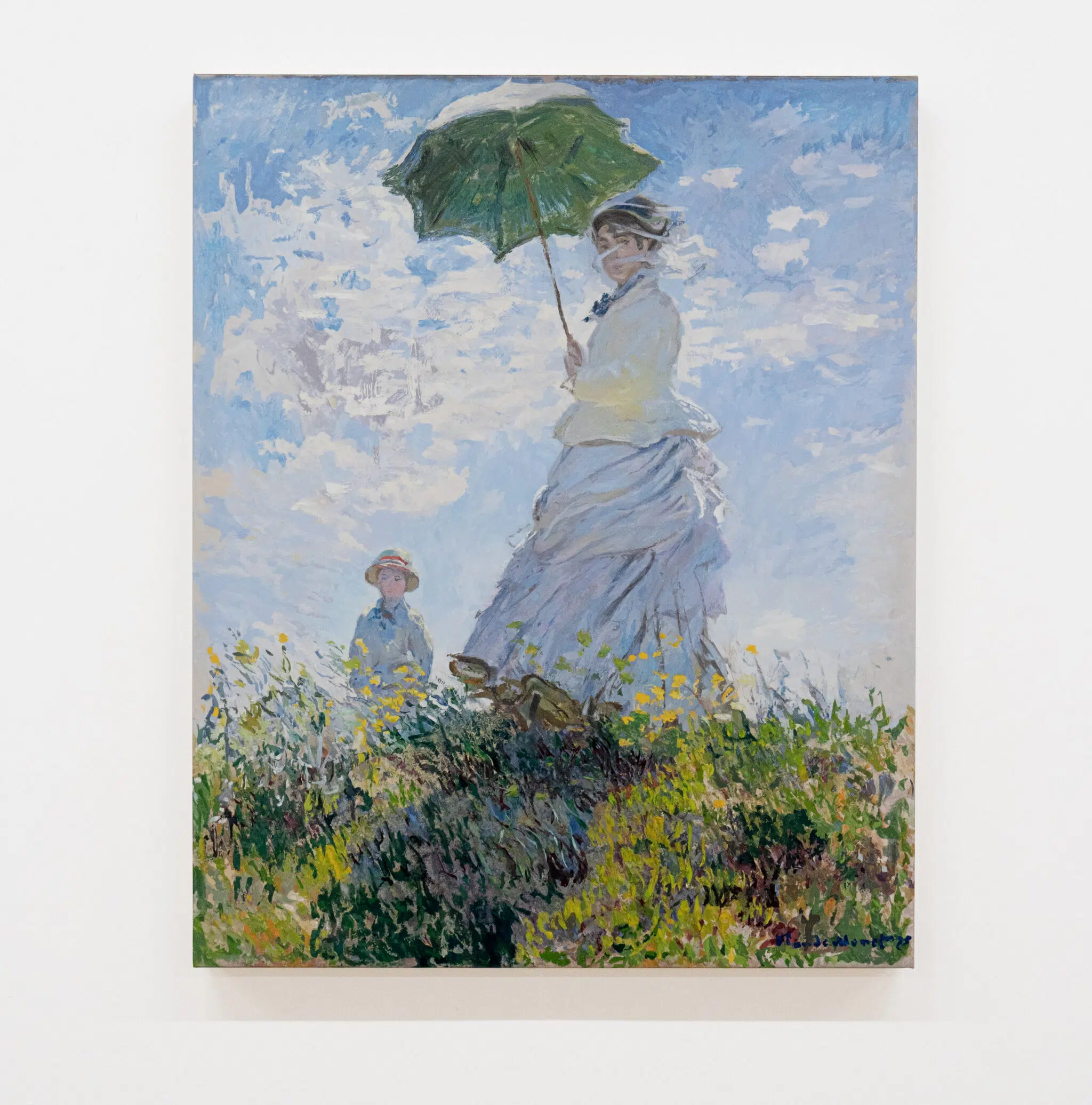
Takashi Murakami, “Claude Monet’s ‘Woman with a Parasol – Madame Monet and Her Son’ A Spacetime of Awareness – SUPERFLAT,” 2025-2026. Acrylic on canvas, mounted on aluminum frame. (©︎2025-2026 Takashi Murakami/Kaikai Kiki Co., Ltd. All Rights Reserved. Courtesy Perrotin)
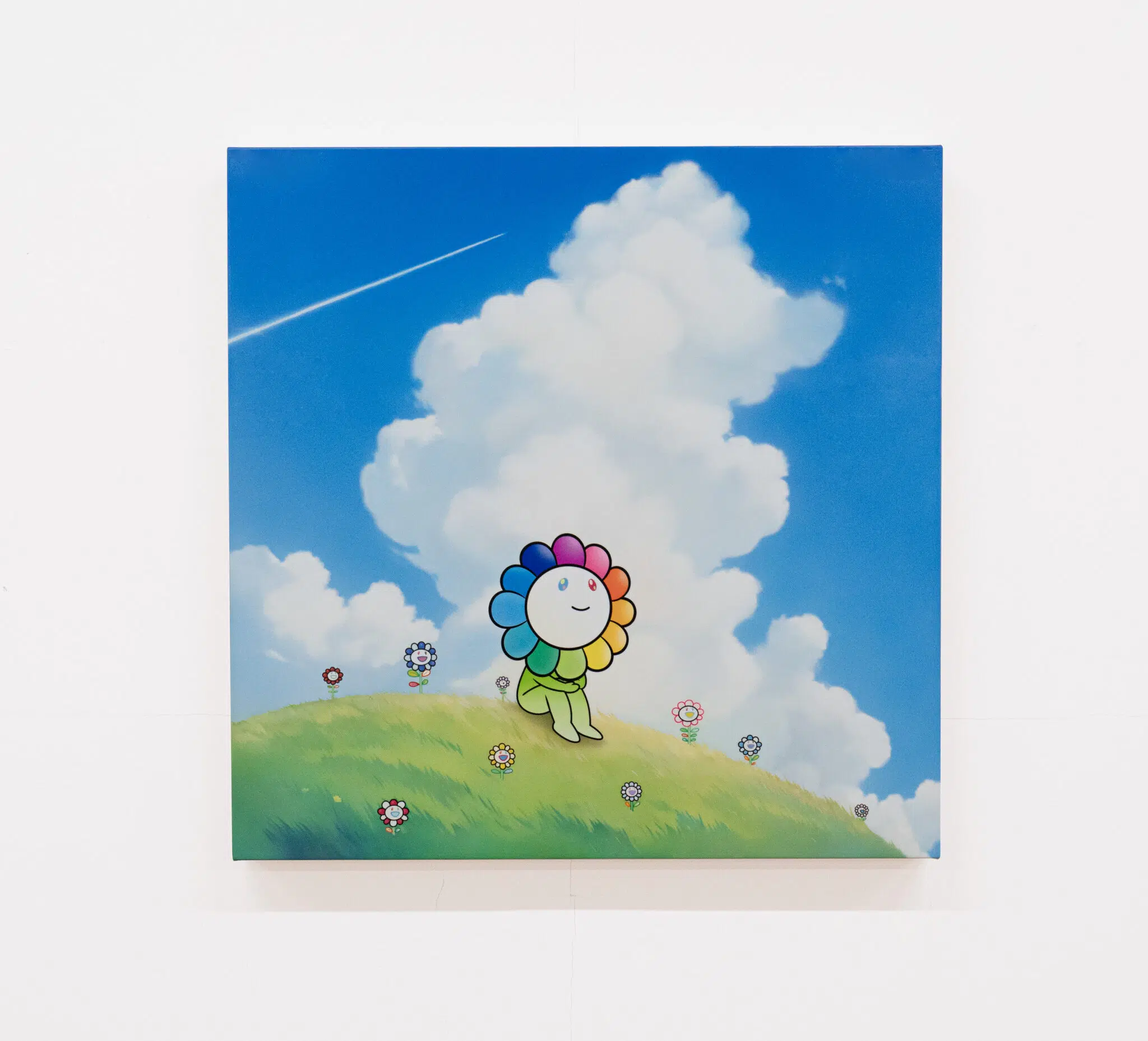
Takashi Murakami, “Flower-Chang on the Hill,” 2025-2026. Acrylic on canvas mounted on aluminum frame. (©︎2025-2026 Takashi Murakami/Kaikai Kiki Co., Ltd. All Rights Reserved. Courtesy Perrotin)
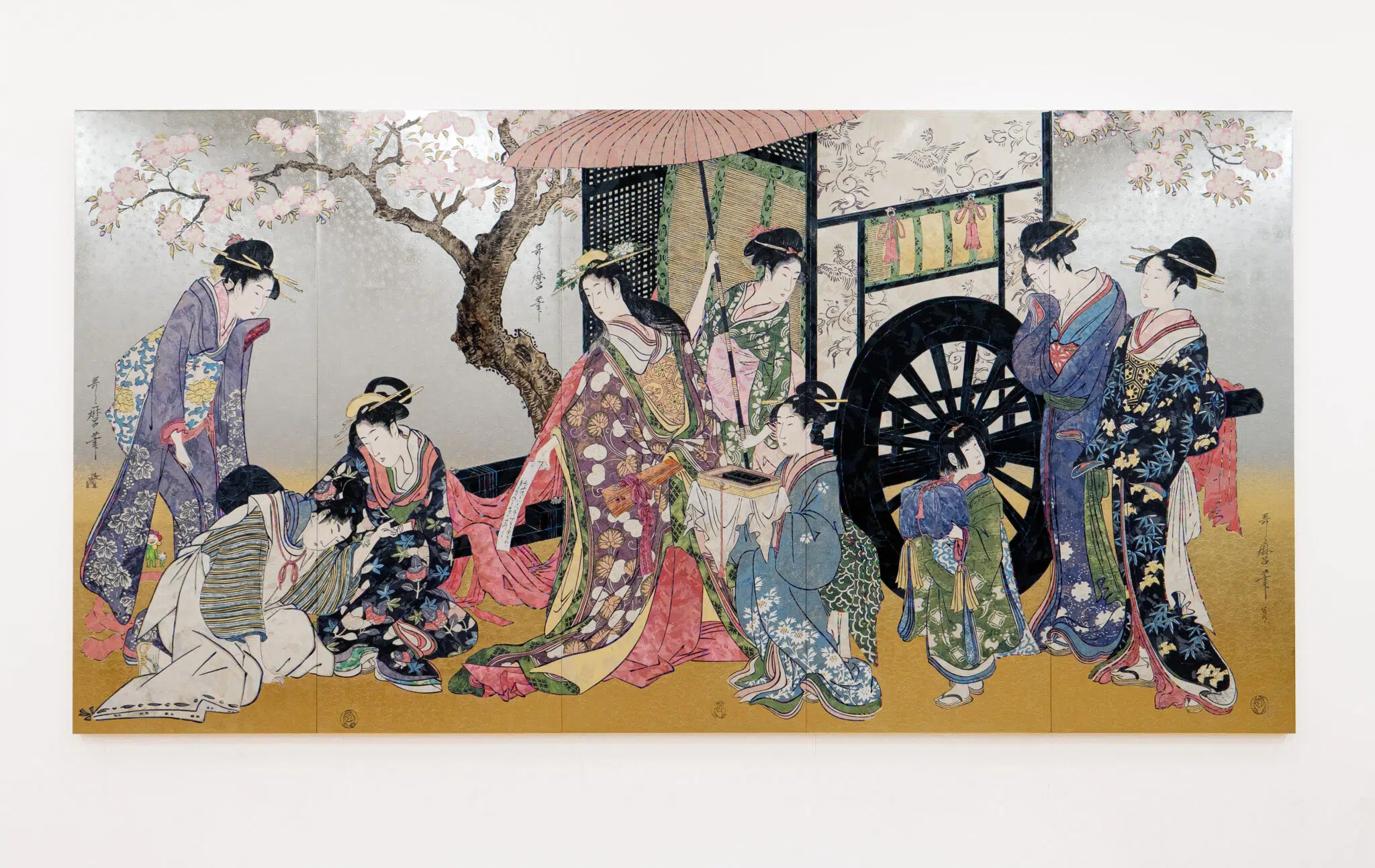
Takashi Murakami, “Kitagawa Utamaro’s ‘Parody of an Imperial Carriage Scene’ Cherry Blossoms Dancing in the Air – SUPERFLAT,” 2025-2026. Acrylic, gold leaf, and platinum leaf on canvas mounted on aluminum frame. (©︎2025-2026 Takashi Murakami/Kaikai Kiki Co., Ltd. All Rights Reserved. Courtesy Perrotin)