

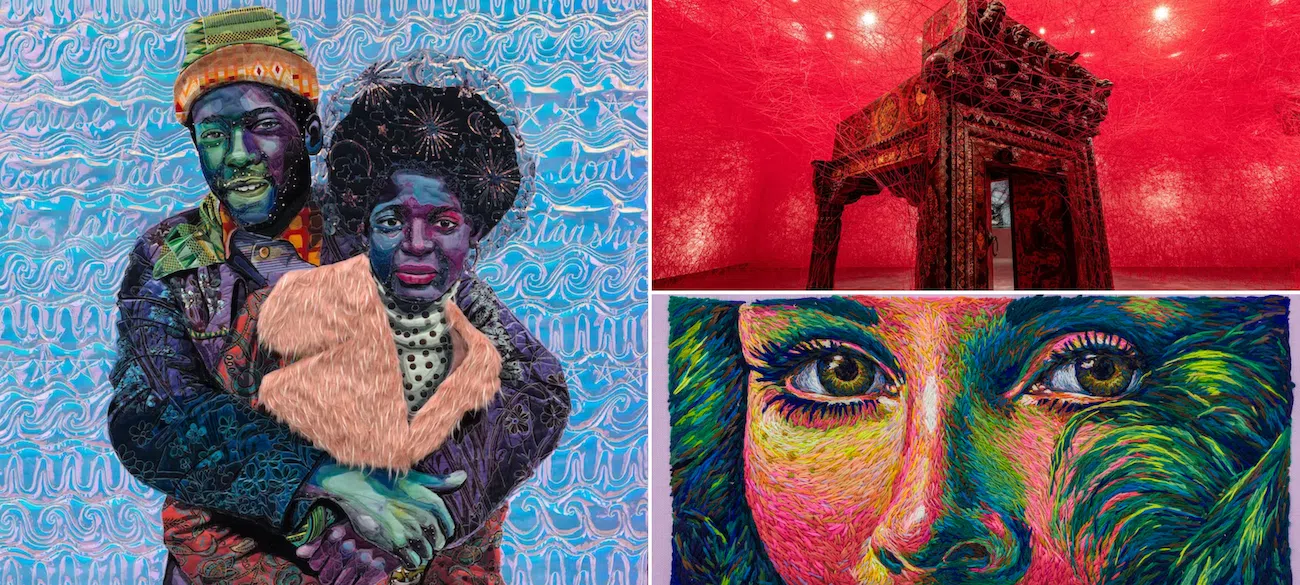
This year, fiber art has been gaining even more momentum in museums and galleries around the world. Just this past spring, the Museum of Modern Art in New York staged a monumental survey of fiber art titled Woven Histories: Textiles and Modern Abstraction. The art market, in turn, has responded accordingly, seeing a price spike in craft-based works. For some, though, this resurgence may come as a bit of a surprise. After all, fiber art has historically been overlooked by established art circles, due in large part to its associations with domesticity, gendered labor, and the “feminine” sphere. On top of that, weaving, crochet, embroidery, and other crafts have often ended up toward the bottom of the fine art “hierarchy,” which prizes painting above much else.
The renewed interest in the variations of this craft is a natural progression, following several decades of mounting advocacy. Beginning in the early- to mid-20th centuries, pioneers such as Otti Berger and Anni Albers were already demonstrating the value of their craft, setting the stage for figures like Sheila Hicks, Faith Ringgold, and Emma Amos to gain greater popularity around the 1960s and after.
Now, in 2025, a number of artists are continuing that same work, proving just how innovative, exciting, and contemporary fiber art can be. Scroll down to see our selection of artists whose work has shined a spotlight on fiber art this year.
Fiber Artists Elevating the Craft in 2025
Janet Echelman
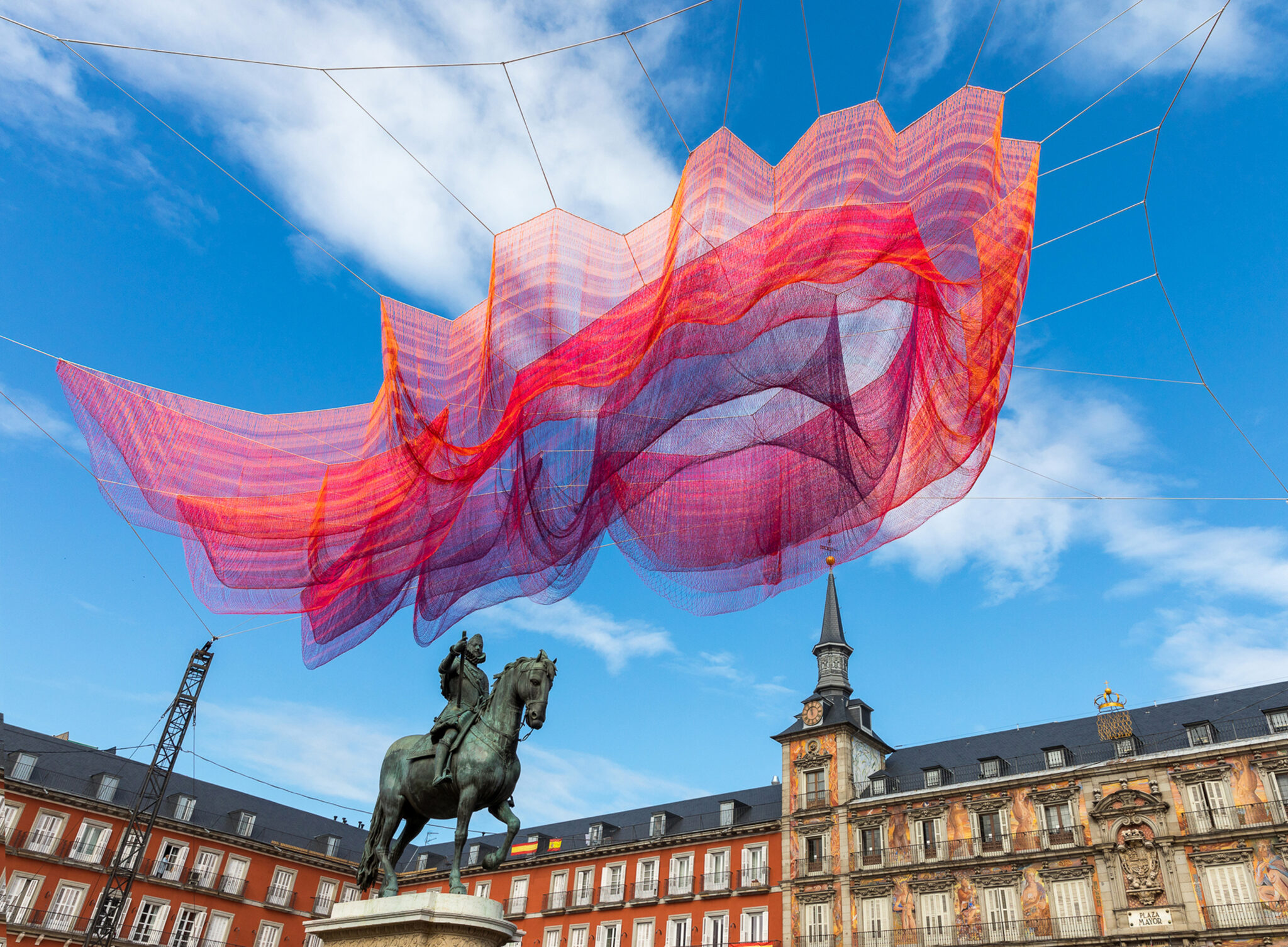
Photo: Joao Ferrand
Since the late 1990s, Janet Echelman has been producing monumental fiber installations, the majority of which she embeds within cities across the globe, including Singapore, London, Vancouver, Santiago, and New York. As public artworks, her vibrant, mesh-like sculptures stretch across urban buildings or hover in the air, inviting viewers to observe how her pieces evolve organically depending on wind, light, or time of day.
“I’m drawn to art that becomes part of daily life, which meets you where you are,” Echelman says. “I’m most delighted with a public art project when it brings people together across different backgrounds, age, education, and cultures.”
Even when situated indoors, Echelman’s installations invite participation rather than simple observation. In the 2010s, for example, she began showcasing her first interior works, including one designed for the Smithsonian’s Renwick Gallery. There, visitors would “come inside” the artwork, lie down on a custom-made carpet, and gaze up at the knotted sculpture above them. No matter their surrounding context, these works vibrate with texture, incorporating physical materials and craft methods that have been passed down for generations.
“For me as an artist, when you enter the art and create your own meaning,” Echelman says, “that is what completes the work.”
Danielle Clough
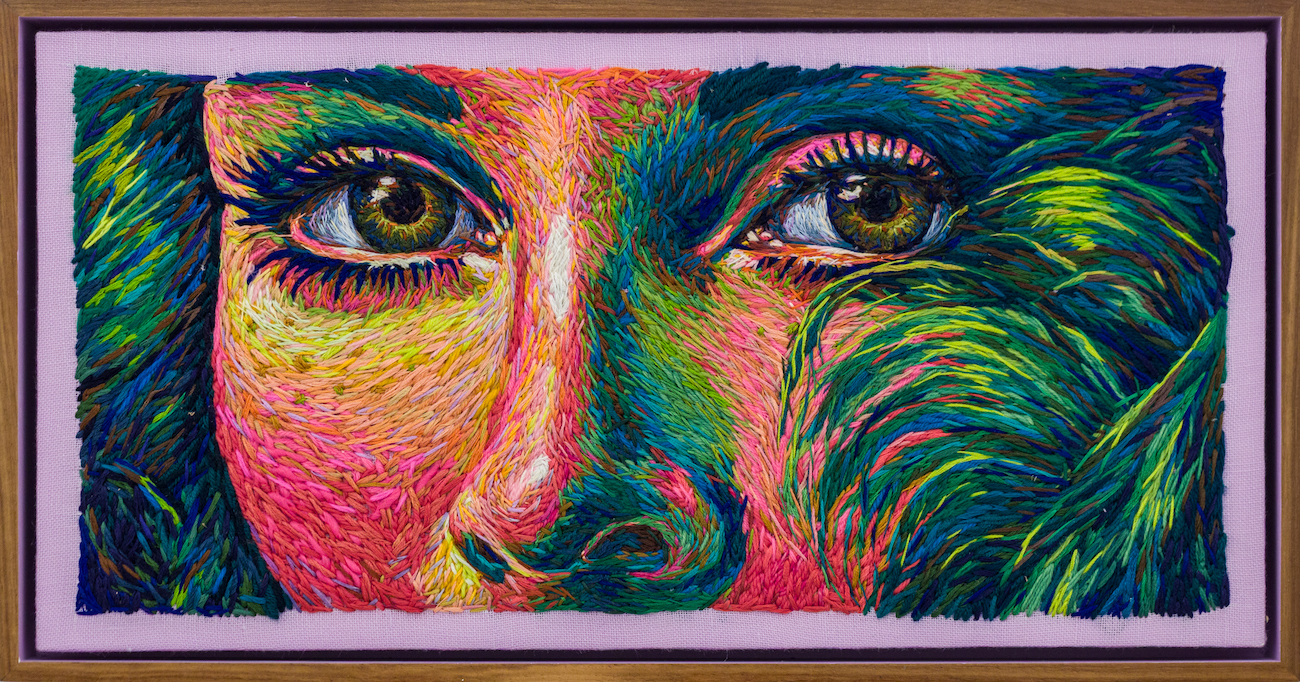
“Crewel Intentions,” 2025, embroidery on linen.
For South Africa–based artist Danielle Clough, embroidery offers a sort of “time warp,” where ancient techniques seamlessly merge with contemporary subjects and tastes. Nothing embodies that better than Clough’s recent exhibition, Crewel Intentions, at Paradigm Gallery + Studio in Philadelphia.
The show gathered several embroidered works inspired by adverts and editorials featured in a vintage Playboy issue, which Clough found some 18 years ago in an antique shop. She then translated these 1970s visuals of pin-up and cowboys into highly saturated, embroidered canvases, exploring how an increasingly vanishing medium—the print magazine—mirrors the trajectory of fiber art.
“Print magazines are a great example of how things come in waves,” Clough explains. “Fiber art is also finding itself front and center in the contemporary art world, yet we have been embellishing cloth since the beginning of time.”
Aside from its subject matter, Clough’s work is also fascinating in terms of its presentation. It’s clear that her canvases are embroidered, and yet they almost appear painted. That tension seems to mimic how, historically, painting has triumphed over countless other media in fine art circles.
“Embroidery has always made sense to me—the pace, the layering, and how tactile it is,” Clough adds. “It’s a gentle indulgence in color.”
Gabriel Dawe
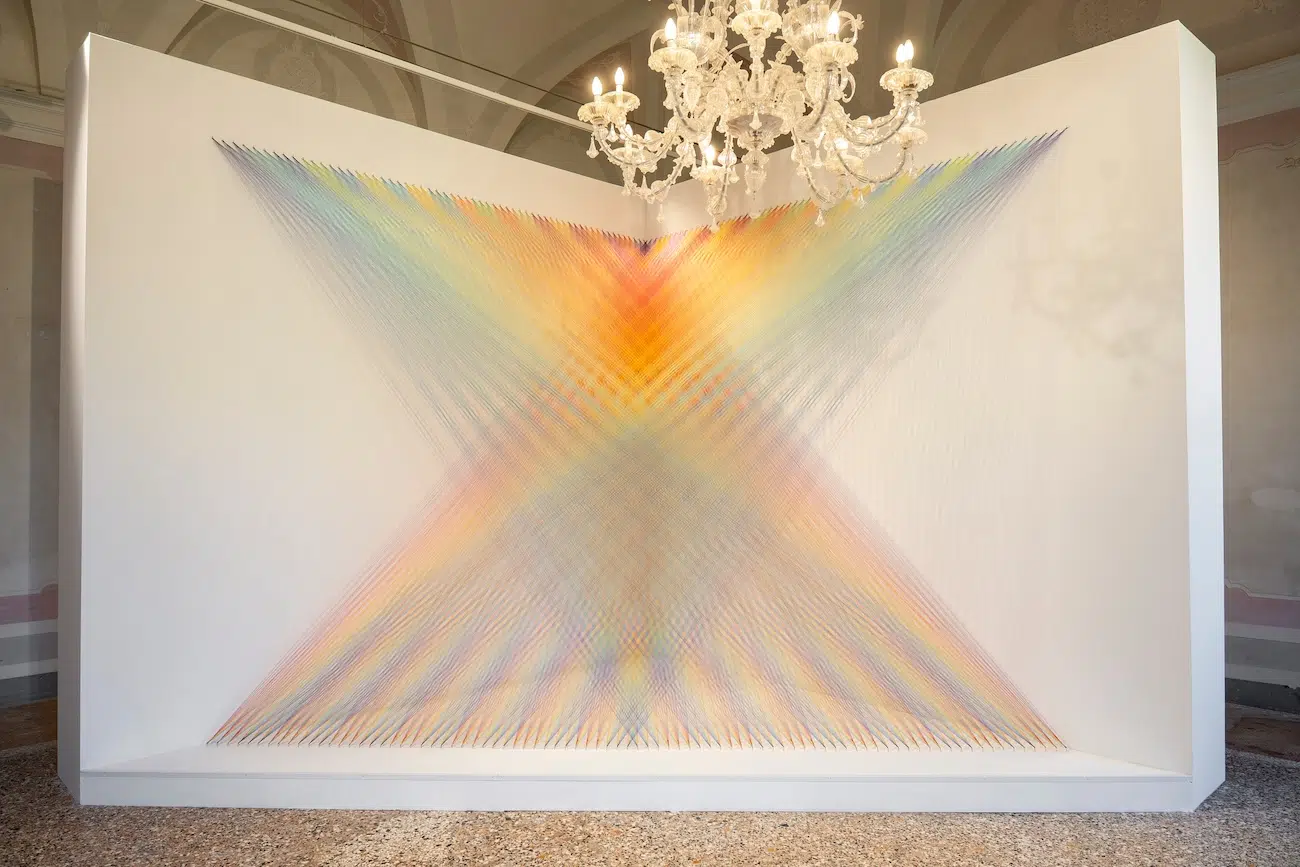
“Plexus no. 46,” 2025. (Photo: Alice BL Durigatto)
Rainbows have something of a hold on Gabriel Dawe. For years, the Mexican artist has been weaving thread into dramatic, angular shapes that resemble beams of light. He then stretches and criss-crosses these webs across a variety of interior spaces, their intersections creating new hues and perceived colors thanks to optical mixing. This magical effect is seen most clearly in Dawe’s Plexus series, which he began as an extension of his embroidery practice to experiment with thread on an architectural scale.
“A really important aspect of my work is the color,” he explains. “Installations really gave me the permission to explore [a] full spectrum [of color]. I’ve always really liked bright colors. I love the idea that all of these different components come together to form a [sense of] unity.”
Though the color spectrum and perception remain at the heart of his practice, Dawe also considers patriarchy and its constraints as some of his most enduring subjects. In fact, the artist picked up embroidery because he wanted to subvert the notions of masculinity and “machismo” which he grew up with in his native Mexico.
“I wanted to challenge the patriarchy in my own small way,” he adds. “I really liked, in the beginning, that these massive installations were stemming from that idea. I still see that connection today.”
Bisa Butler
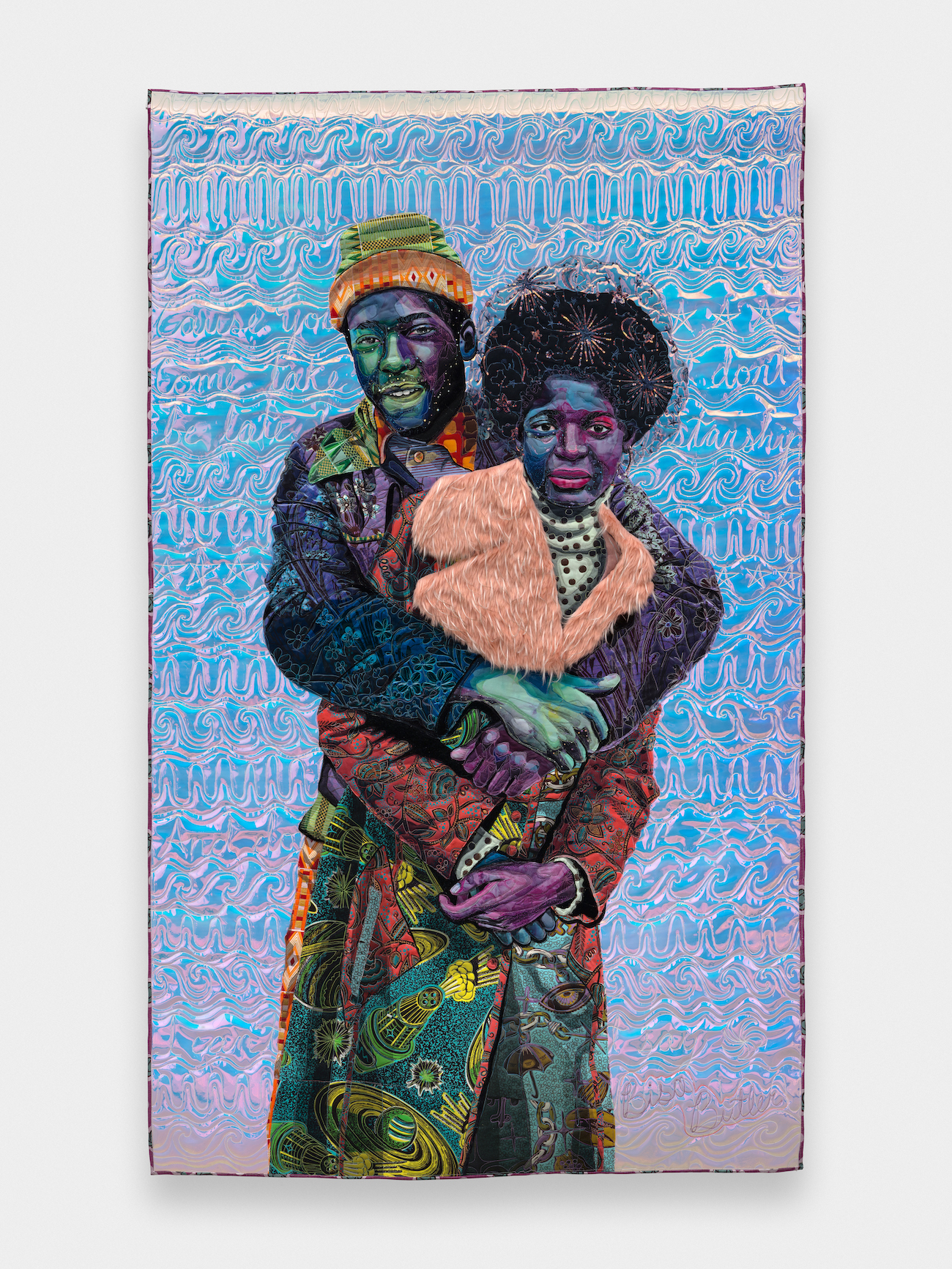
“Hold Me Close (My Starship),” 2025, after “Untitled,” 1974, by Steve Edson. Cotton, silk, lace, sequins, netting, vinyl, faux fur, and velvet, quilted and appliquéd. (Photo: Mark Woods, courtesy of the artist and Jeffrey Deitch)
Across her work, Bisa Butler celebrates the rich history of Black identity and craft traditions, with a particular focus on quilting. The artist weaves countless threads of influence throughout her quilts, all while playing with a rich array of materials, including faux fur, vinyl, cotton, silk, lace, sequins, and velvet. There’s a rare sense of confidence in Butler’s work, expressed not just through her command over several media, but also through her vivid color palettes, evocative textures, and engaging storytelling.
This fall, Butler held her most recent solo exhibition, Hold Me Close, at Jeffrey Deitch Gallery in LA. Throughout the show, Butler considered themes such as mutual respect, love, and unity, all critical remedies during an era of increased fracture and upheaval.
“This body of work is a visual response to how I’m feeling as an African-American woman living in 2025,” she noted in a statement. “In times of crisis, we need each other more than ever. A kind word, a sympathetic ear, and an offer to help make us feel more human.”
Chiharu Shiota
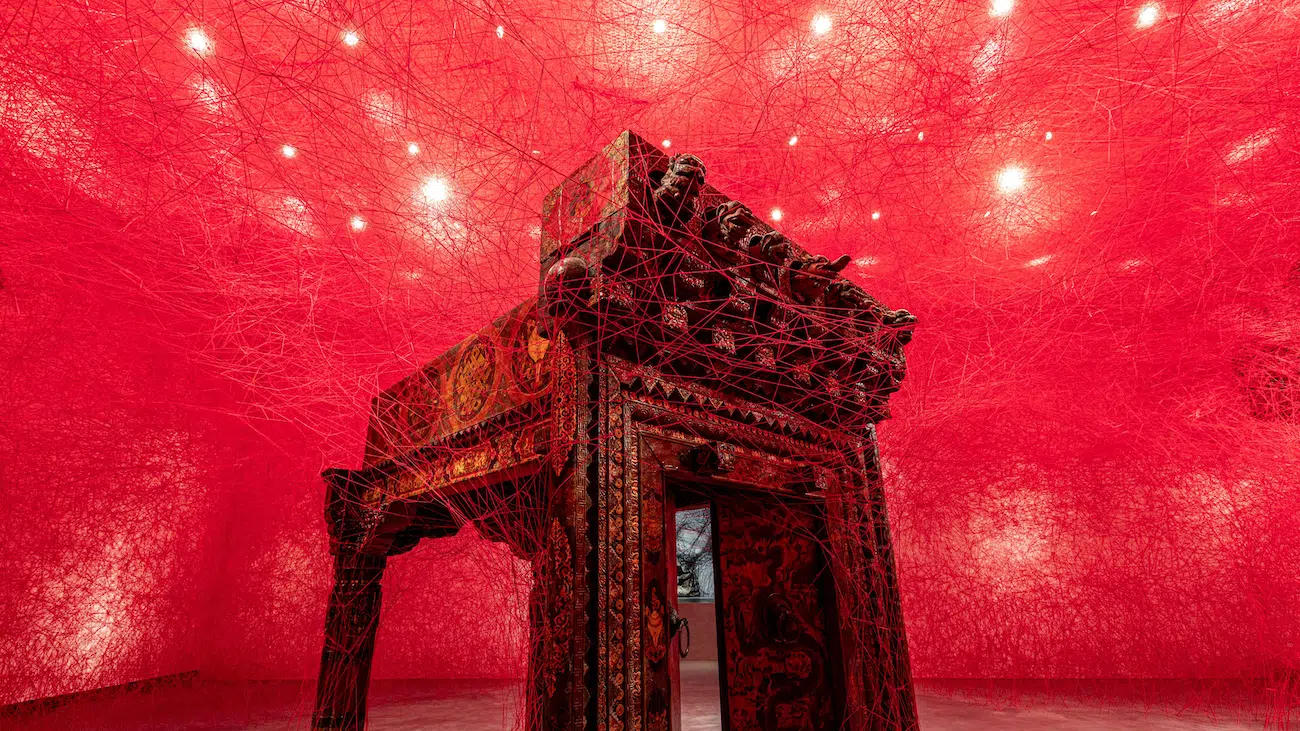
“Gateway to Silence,” 2025. Antique porch, red wool.
When Chiharu Shiota finally began using thread, she remarked that she “felt like I found my material. I could express my emotions.” For years, the Japanese artist has produced dramatic, site-specific installations that engulf ordinary objects like shoes, keys, beds, chairs, and dresses within webs of thread. That said, Shiota is careful to distinguish her fiber art, insisting that her art should not be read as cobwebs, but rather as paintings. It’s clear, then, that threads are brushstrokes and her installations are canvases, delicately painted and suspended in the air.
“My work is about connection. I believe we are all connected, and it’s impossible to be part of society without those connections,” she says. “It’s also about memory. The web of threads reminds me of the brain and the neural system, filled with memories and our existence.”
Recently, Shiota’s command over craft, space, and form was on full display at the Red Brick Art Museum in Beijing, which hosted her recent solo exhibition, Silent Emptiness.There, visitors encountered a simple white bed with white sheets and, floating above it, hundreds of transparent tendrils; an ancient Tibetan Buddhist door enveloped by a criss-crossing network of red threads; and a wooden boat hidden by red ropes.
“I always need to visit the museum space before I can think about what to create,” Shiota adds. “Only by seeing the space can I imagine what will fit.”
Ian Berry
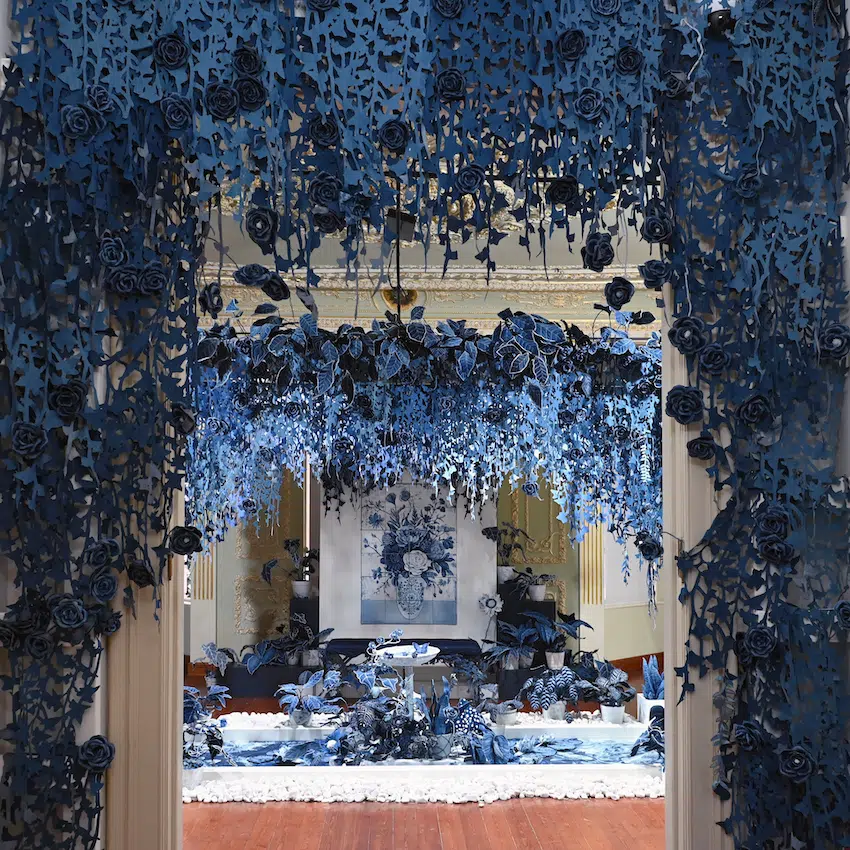
Throughout his art, Ian Berry proves that denim can be used for so much more than jeans. For the past two decades, the British artist has been transforming discarded blue denim into intricate installations, iconic portraits, and photorealistic depictions of California, emphasizing sustainability while also working with an unexpected medium.
The Secret Garden may showcase that philosophy best. First exhibited at New York’s Children’s Museum of the Arts in 2017, the installation reimagines a serene setting with a fish pond, flowers, and vines, all designed with a young audience in mind.
“The idea came from thinking many kids don’t have their own gardens and thinking of community gardens nestled away in between buildings and trying to inspire them to seek that out,” Berry says. “It also gave the opportunity to talk about sustainability as well as helping young minds think about where things come from.”
Earlier this year, Istanbul’s Kaylon Kültür hosted a sprawling solo exhibition, Beyond Denim, that featured a curated collection of Berry’s work throughout his career, including The Secret Garden.
Vanessa Barragao
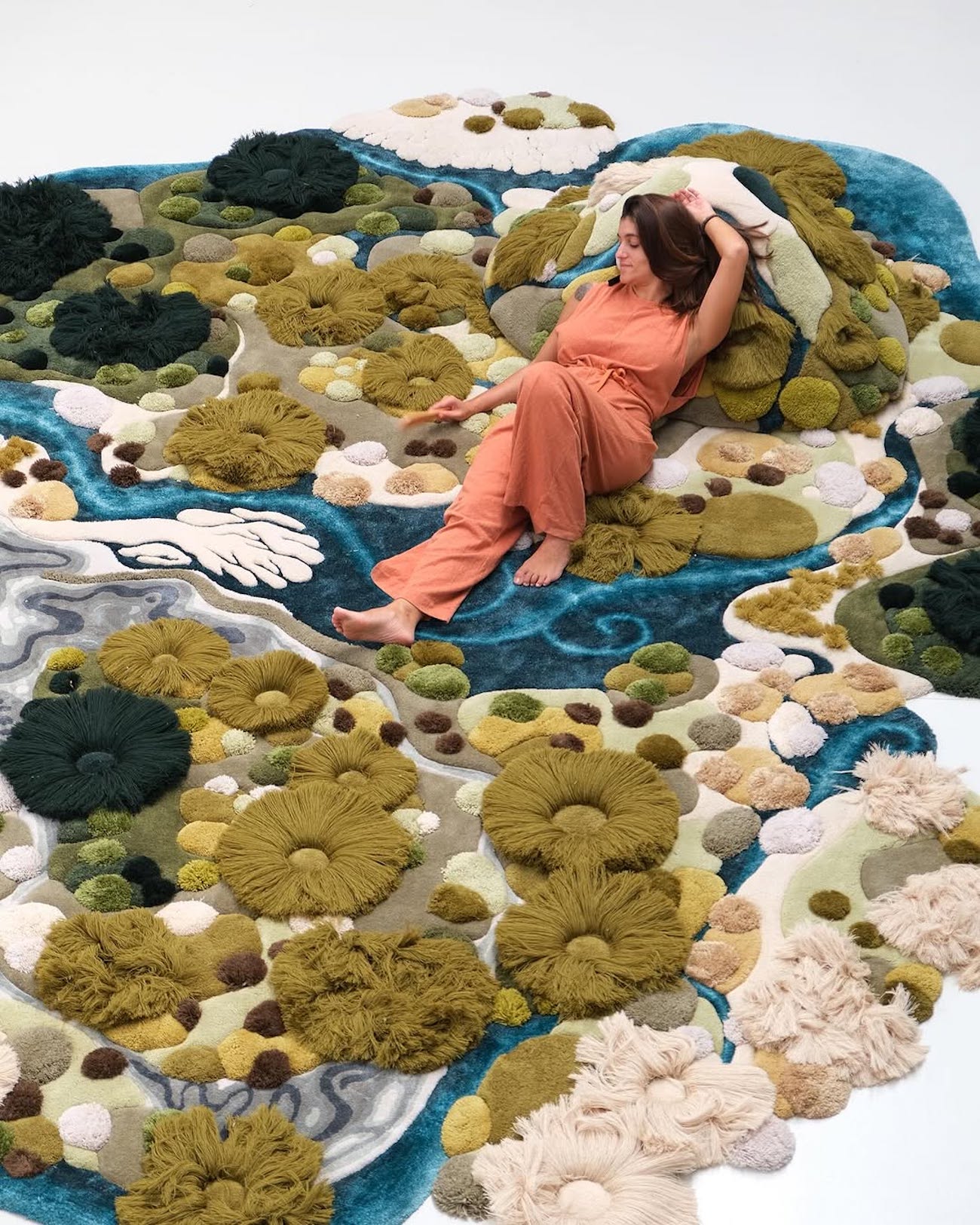
For Vanessa Barragão, fiber art is more than simply a form of creative expression. Rather, it’s a vehicle to connect with ancestral tradition, all while raising awareness for the impacts of climate change. The artist’s practice revolves around sustainable and eco-friendly materials, a preference that is also reflected in the topics toward which she gravitates.
While visiting Ōtepoti Dunedin on New Zealand’s South Island, for instance, Barragão was instantly struck by inspiration. The rugged coastlines, rolling hills, and abundant wildlife quickly gave rise to her Dunedin piece, which beautifully captures the diverse textures and vibrant colors of the country’s landscapes through colorful wool yarn. Thanks to her tufting technique, Dunedin vibrates with depth, bringing blue bays, sandy beaches, and rolling hills to life in thoughtful, three-dimensional detail.
Last month, Barragão was also invited by Visit Portugal to upcycle materials from the Portugal Pavilion following the World Expo in Osaka. The project complements the artist’s emphasis upon sustainability, while also building upon her live performance at the Expo during which she experimented with ropes.
“During my visit to Japan, I realized that I’m the fourth generation in my family practicing the crochet technique,” she recently remarked. “This craft now holds a different meaning to me. Through my hands flows all the knowledge from my mother, grandmother, and great-grandmother. That feeling is truly beautiful.”
Lucy Sparrow
View this post on Instagram
This summer, Lucy Sparrow launched Bourdon Street Chippy, a cheeky version of a traditional fish-and-chip shop in London’s Mayfair area. The catch? The 65,000 items found within were all meticulously crafted out of felt. Given the project’s sheer scale, it’s particularly impressive that it only took eight months for Sparrow to produce everything, ranging from mushy peas and ketchup bottles, to clocks and menus. The artist even created a “Bourdon Street Wall of Fame,” featuring portraits of over 50 actors, artists, and celebrities.
“Some are friends of the felt and have been to my shows before, and many more are my dream customers or personal heroes,” she told Dezeen in a recent interview.
In the past, Sparrow has spearheaded similarly playful interventions, also composed entirely of felt. In 2018, for instance, she reimagined a supermarket in LA, complete with 31,000 felt groceries like sushi rolls, avocados, and chips. Even earlier, in 2015, she tackled “prudery” with a stitched sex shop in London’s Soho neighborhood.
“My work focuses on nostalgia and shared experience; the communal places that we all know and love, and the chippy is such a strong example of that.”
Honorable Mention – Fiber Art Exhibition
The Golden Thread 2
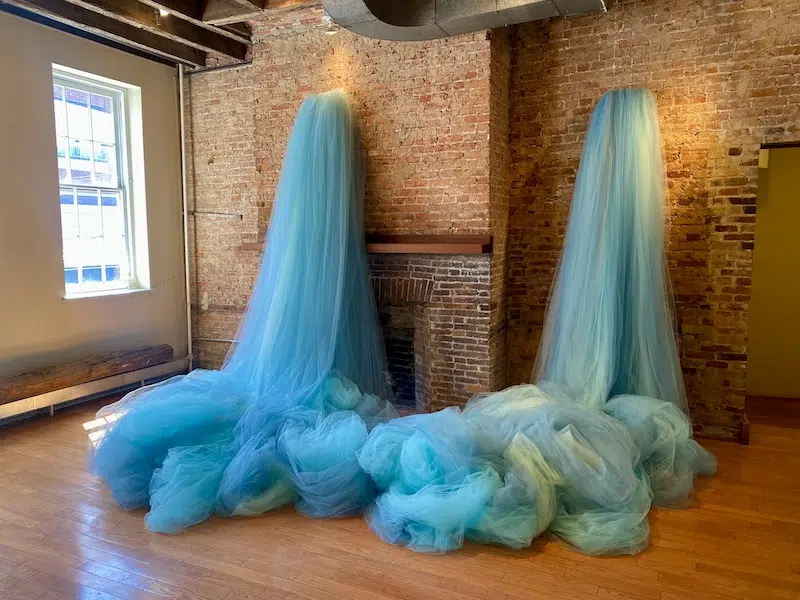
Ana Maria Hernando, “El intento del agua/The Intent of Water,” 2025.
We would be remiss to exclude The Golden Thread 2 as an honorable mention—even though it’s an exhibition! Hosted by BravinLee Programs this May in Manhattan’s South Street Seaport neighborhood, the exhibition gathered the work of 60 contemporary fiber artists. As its name implies, The Golden Thread 2 built upon the first iteration of The Golden Thread, open for only a few days to coincide with Frieze New York in 2024.
Taken in its entirety, The Golden Thread 2 weaved a compelling narrative about the artists working at the forefront of contemporary fiber art, showcasing pieces like a charming pipe cleaner mural of a lion and unicorn, a finger-knit vase; a macramé sun that just barely loomed above the wooden floor, denim jeans complete with manually stitched threads, and so much more. One highlight in particular was Ana Maria Hernando’s The Intent of Water, which incorporates tulle, felt, and velvet. These materials beautifully embodied the artwork’s title, carrying a rare sense of buoyancy and softness, much like water gurgling down a stream.
Related Articles:
Fiber Artist Crochets Beautiful Lacework Designs on Fallen Leaves
Nontraditional Fiber Artist Seamlessly Weaves Beautiful Circular Creations
Fiber Artist Crochets Colorful Dishes That Look Like a Chef Prepared Them